

“Elvis, I’m really just here to compare rates.”
That was the first thing the client said.
He’d bought a presale three years earlier and completion was coming up. To save time he went to the bank he’d always dealt with.
The answer came back quickly: the rate was fine, but the amount fell short by a six-figure margin.
He couldn’t make sense of it. “My income hasn’t changed. It’s the same property. Why isn’t the amount enough?”
And the question underneath that one: “If one bank has already said no, would another bank really be any different?”
It’s a question a lot of people arrive with. They come in to compare rates, and leave realising the rate wasn’t the only thing worth comparing.
A mortgage isn’t a maths problem with one right answer
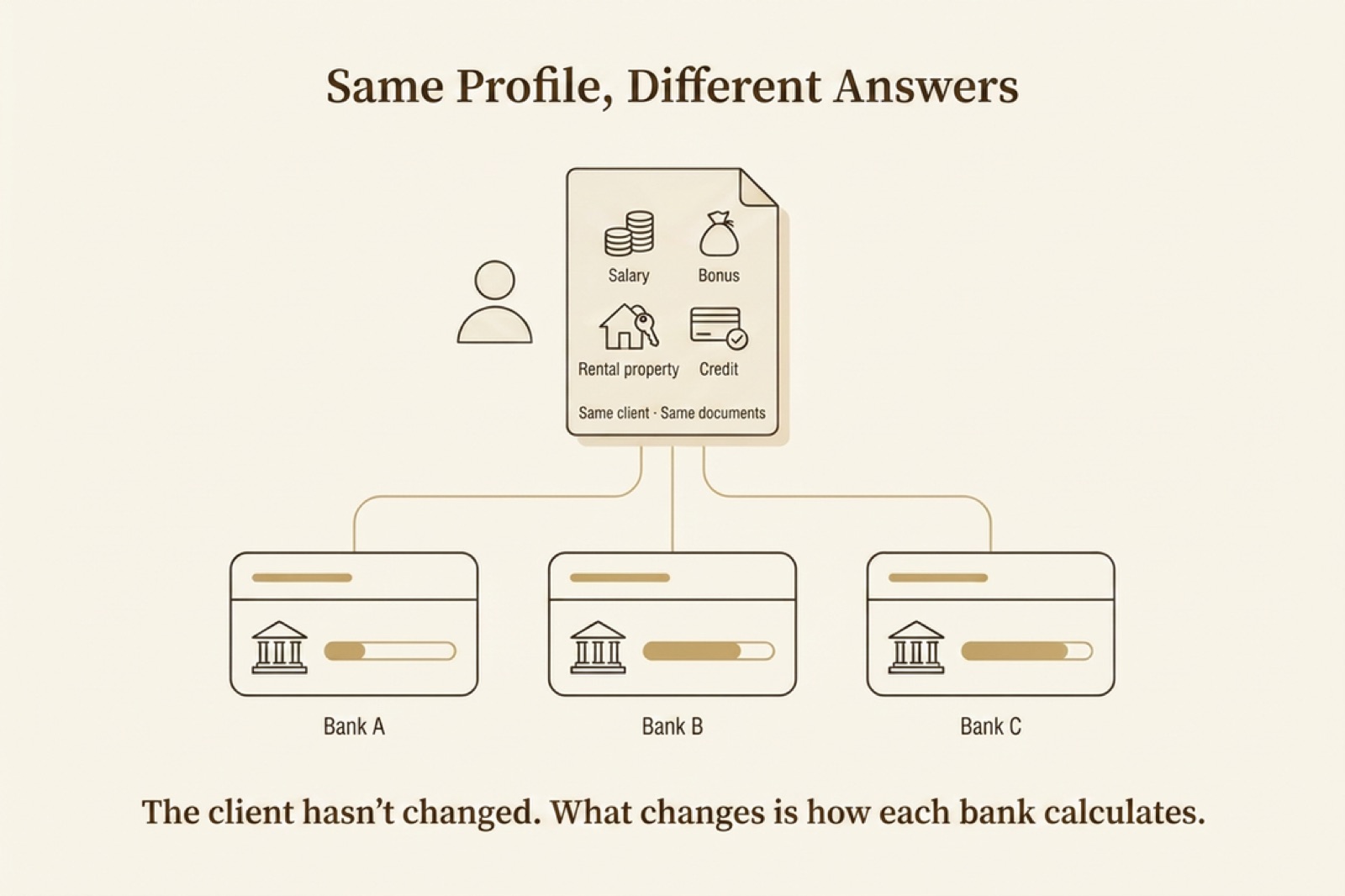
People assume that identical documents should produce identical results.
But a mortgage isn’t income minus debt equalling a fixed number. Every bank looks at income, debt, credit and the property — how each one interprets and calculates those can differ.
Example one · salary plus bonus
Say a client has a base salary and a long, steady record of bonus income. One bank may work primarily from base salary. Another, where the record is consistent enough, may bring part of the bonus into the calculation.
Example two · a rental property
Or say a client owns a rental. How the rental income is counted, and how the property’s costs land in the debt ratio, can be handled differently from one lender to the next.
The client’s profile hasn’t changed. What changes is how each bank calculates it.
So the amount one bank arrives at reflects that bank’s own assessment method. It isn’t necessarily the only answer available.
What matters isn’t switching banks — it’s finding the problem first

The follow-up question is usually: “So would another bank definitely lend more?”
Not necessarily.
One bank saying no doesn’t mean there’s no way through. It also doesn’t mean another bank will solve it. What matters first is working out what actually blocked this application.
Sometimes it’s how the income was counted. Sometimes rental income wasn’t fully recognised. Sometimes the debt ratio capped the amount. And sometimes the constraint is genuinely on the client’s side — income that doesn’t stretch, debt that’s too high, a credit issue, or a funding gap.
Different causes call for completely different responses.
If the problem came from one bank’s assessment method, another lender may handle it differently. But if it comes from the client’s own position, changing banks doesn’t make it disappear.
Which is why a mortgage broker’s real value isn’t knowing more banks, and isn’t submitting the same file around to see what sticks. It’s understanding the client’s whole position first, then judging which lender’s policy and which structure actually fit it.
Looking for more options isn’t working around the rules. It’s finding, within them, the option that fits the situation better.
How we see it

People treat a bank’s answer as the definitive one. We’d say a mortgage is closer to a match.
Income structure, debt, assets and what the property is for all differ from client to client. Products, policies and what each lender scrutinises differ too. One bank’s answer matters — it just doesn’t necessarily represent everything that’s possible.
That’s why, when we compare mortgages for a client, the first question isn’t “who has the lowest rate?” It’s “which structure actually fits you, and gets you to completion?”
When a bank gives an answer, the more useful work isn’t rushing to the next bank. It’s understanding why that answer came back the way it did.
Because only then can you tell whether there’s a better option available.
This article is general information. It is not an approval, a quote, or financial, tax or legal advice. What you can actually borrow, and on what terms, is determined by a licensed advisor after reviewing your full file.
First published on Guaranti’s WeChat account.