
Suppose you set aside $25 a week for your child, starting today.
What do you think that changes?
Most people say the same thing: $25 isn’t much.
They’re right about the amount. But what moves the outcome here isn’t the amount. It’s the runway.
What compounding actually does
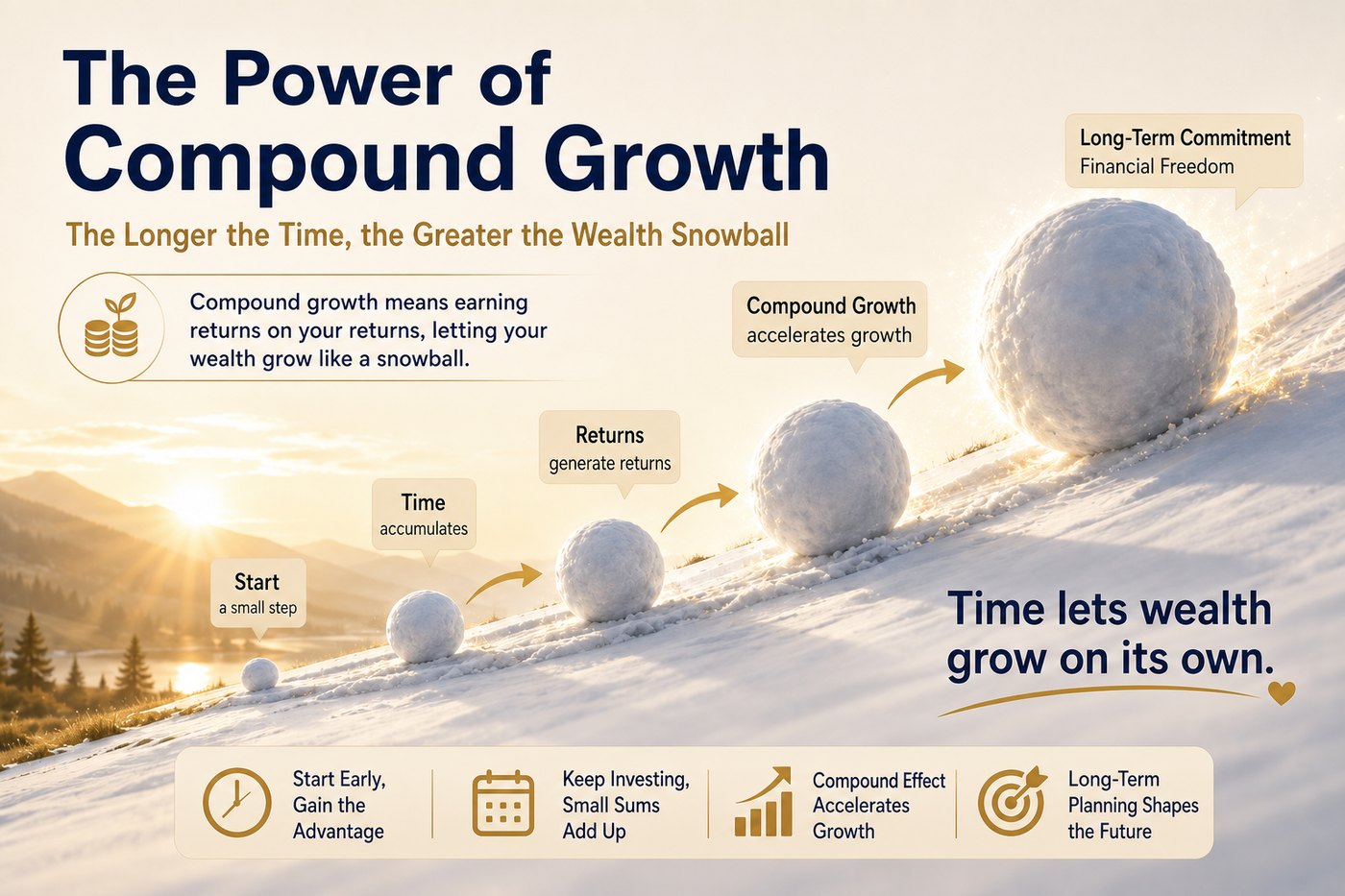
Compounding is straightforward to describe and difficult to feel. Your principal earns a return. That return then earns a return of its own. And so on.
Over a short period, this is barely noticeable. Over decades, it stops behaving like addition and starts behaving like a snowball — which is why the length of time matters more than almost anything else in the calculation.
A simple illustration
Two children. Same habit, same assumed rate, same finish line.
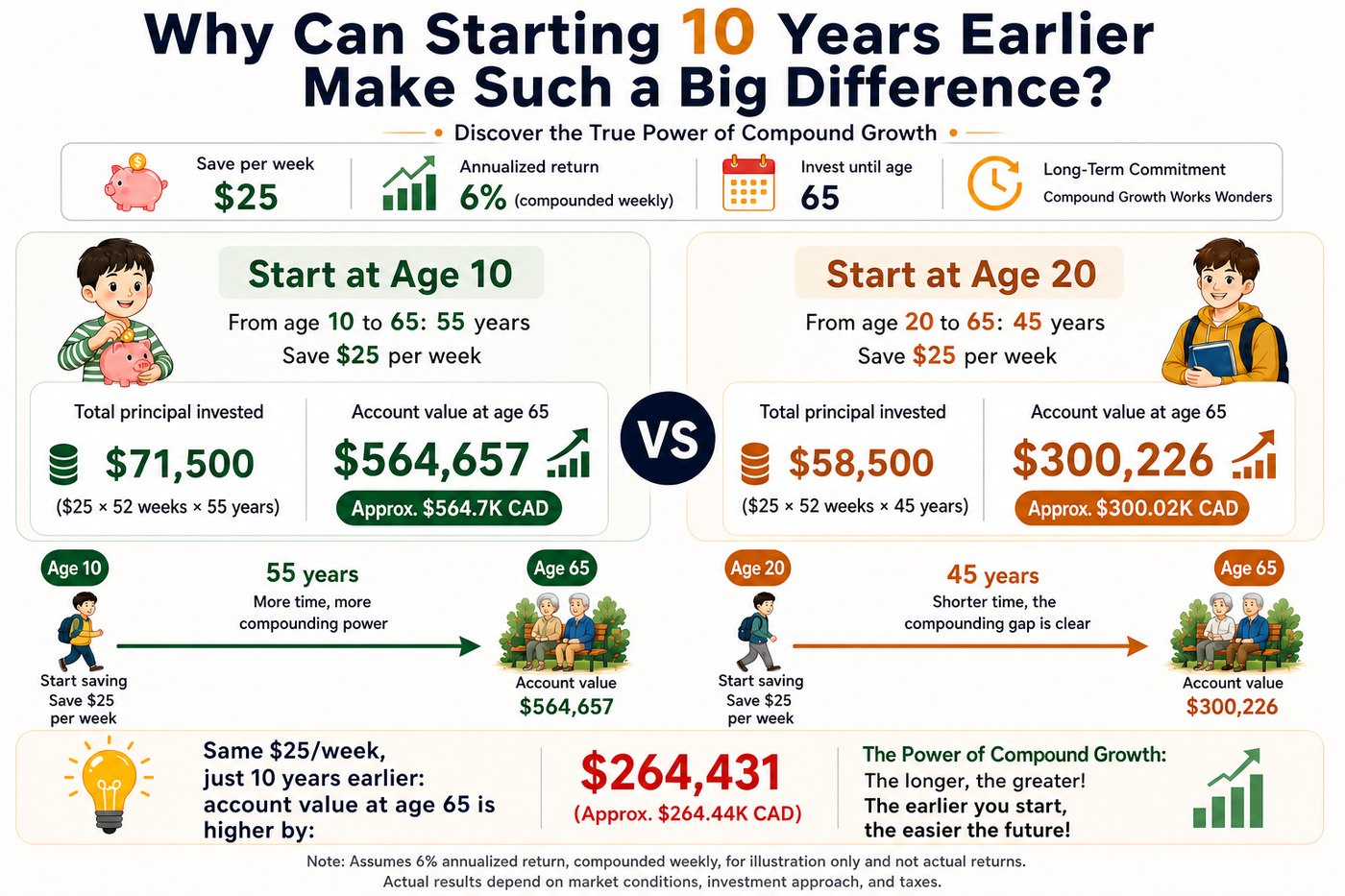
Child A starts at ten. Saves $25 a week. Assume a 6% annual return. Keeps going to 65.
Child B starts at twenty. Same $25 a week, same 6%, same finish at 65.
Identical contributions. One difference: ten years on the front end.
The result is larger than most people guess
Under those assumptions:
Starting at ten — $25 a week for 55 years. Total contributed: $71,500. Account value at 65: about $564,657.
Starting at twenty — $25 a week for 45 years. Total contributed: $58,500. Account value at 65: about $300,226.
The difference is roughly $264,431.
Notice what did not cause it. Not a larger contribution — the gap in principal is only $13,000. Not a better return — the rate was identical.
Ten years. That’s the whole explanation.
Time is compounding’s closest ally
When families plan, the instinct is to hunt for a better rate of return.
For long-horizon accumulation, time usually matters more. The earlier you begin, the longer compounding has to work, and the more room the outcome has to grow.
What this means for teaching children about money
More families are thinking about financial literacy for their children — not because they expect them to build wealth at twelve, but because a few ideas land better early than late:
- That saving is worth doing
- That consistency beats intensity
- That time is an asset
- That compounding is real, and slow, and then not slow
Those habits tend to outlast any single gift.
Our view
Financial advantage often comes less from a better return than from an earlier start.
Families searching for the highest-yielding product frequently overlook the one variable they can’t buy back later. For a child in particular, the habit of saving, an understanding of compounding, and a sense of what money is for will shape more of their life than a lump sum ever will.
Good planning isn’t only about earning more. It’s about doing the right thing at the point when it still has time to matter.
The figures above are an illustration based on stated assumptions — $25 weekly and a 6% annual return, held constant. They are not a projection, a recommendation, or an indication of what any particular investment will do. Actual returns vary and can be negative.
First published on Guaranti’s WeChat account.