

Should I incorporate?
Incorporating in BC isn’t difficult. Fill in the details online, submit the application, pay a few hundred dollars, and it’s done in short order.
Which is why most founders take the reasonable view: get the company set up, deal with the rest later.
A real case
One business owner incorporated on his own to save time and money.
Several years on, the business had stabilised and he was preparing to bring in a partner. He assumed this meant adjusting the shareholdings — a straightforward change.
Speaking to a lawyer, he found otherwise. Because the share structure had been set up without reference to where the business might go, the company’s constating documents had to be revised and the rights and obligations between shareholders reconsidered from the ground up.
It was resolved. But it took considerably more time and cost than it would have taken to think it through at the outset.
This is not unusual. In most of these situations nothing has gone wrong with the business. The problem is that the business started growing and the structure underneath it didn’t scale.
Incorporating is the beginning, not the arrangement
In the early days everyone’s attention is elsewhere — building the product, finding customers, hiring.
Very few people sit down and ask:
- What happens if we want to bring in a new shareholder?
- If we need to raise capital, will the structure accommodate it?
- Once the business is profitable, how are the economics arranged between shareholders?
- If I retire, sell, or pass this to my children — what does that look like?
At the outset these feel remote. But many of them are effectively decided on the day of incorporation, whether or not anyone intended to decide them.
Incorporating gives a business a lawful basis to operate. What determines how far it can go is whether the structure underneath supports where it’s headed.
The problem is rarely the business. It’s the structure.
Companies pass through stages — expansion, financing, bringing in partners, wealth planning, eventually succession. Each stage asks different questions.
Where the original structure didn’t account for the direction of travel, it can usually still be changed. But changing it later takes time and requires a lawyer, an accountant and often other advisors working in coordination.
Which is what most owners eventually conclude: the thing that needed planning was never whether to incorporate. It was whether the structure could support what came next.
Incorporation solves today. Share structure is about tomorrow.
The lawyers we work with make a distinction most founders don’t:
Incorporating and structuring a company are two different exercises.
Incorporation makes the business a legal entity. Structuring asks whether, as the business grows, it can keep developing along the lines the founder intends.
For example:
- Might you bring in new shareholders or investors?
- Does the founder want to retain control?
- How will shareholders work together, exit, or transfer shares?
- Is financing, a sale, or succession plausible in future?
There’s no universal answer. Different businesses at different stages with different objectives call for different arrangements.
What matters is thinking about the destination at the point of incorporation, rather than reverse-engineering it once the next stage has already arrived.
Our view
We meet a lot of business owners. Most come to us about lending, financing or wealth planning.
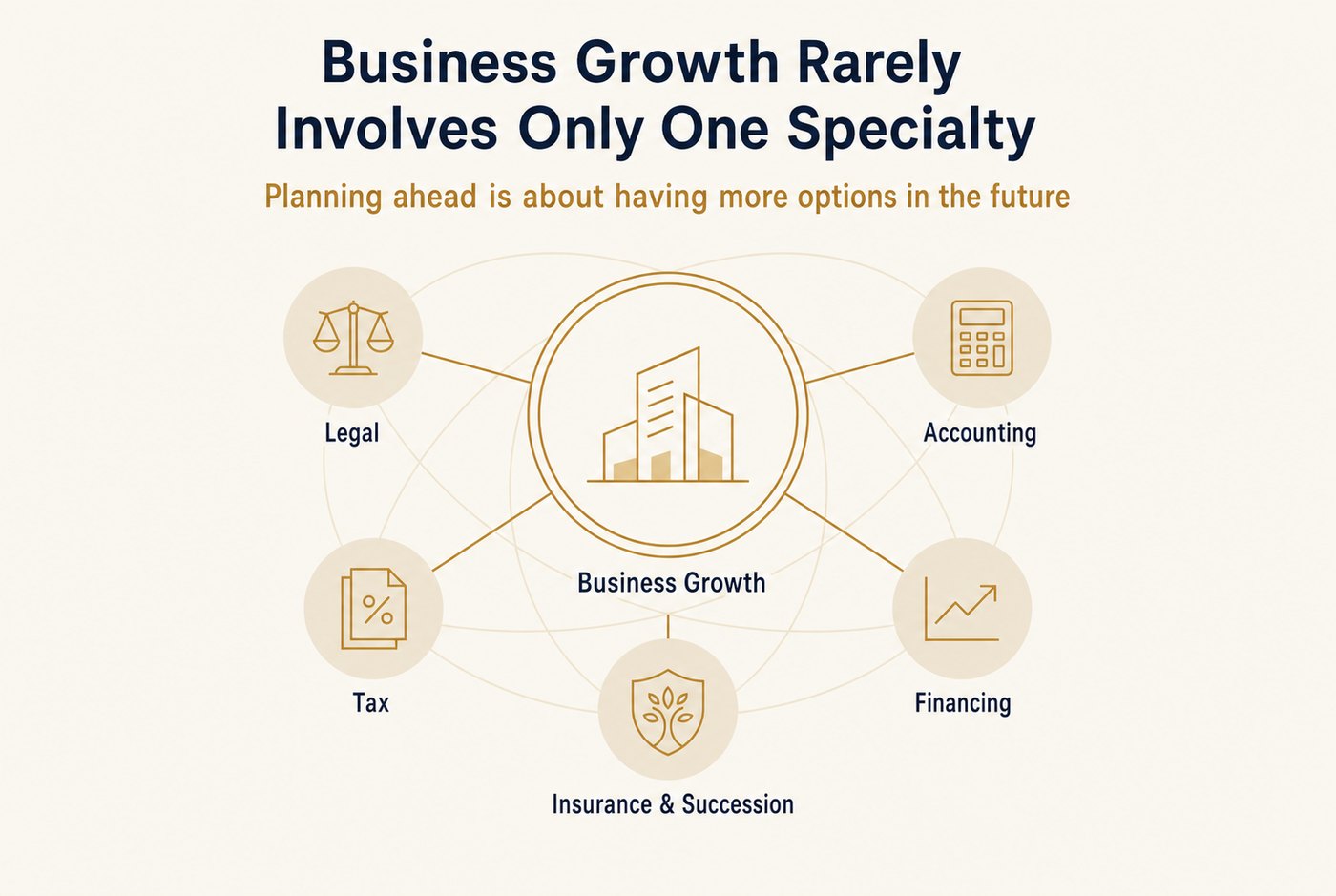
Talk it through and the real subject is usually broader. Share arrangements, business risk, financing plans, wealth management, insurance and eventual succession all touch each other.
Business development rarely stays within one discipline. A financing round can implicate the corporate structure. A wealth plan can affect succession. An expansion can require a lawyer, an accountant and a tax advisor at the same table.
So what we try to build with clients is a longer view — coordinating lawyers, accountants and tax advisors as the business moves through its stages, each contributing within their own scope, so that individual decisions serve where the company is actually going.
Planning ahead doesn’t make things more complicated. It leaves more options open.
A closing thought
Running a business is a long undertaking.
The name can change. The office can move. The business lines can be reworked.
The underlying structure tends to shape a great many decisions that come afterwards.
Incorporation isn’t the finish line. It’s where the planning starts.
If you’re preparing to incorporate, or already run a company and want to prepare it for what’s next, it’s worth an extra conversation with a lawyer and the other advisors involved.
An hour of planning now often saves months of restructuring later.
This article is general information, not legal or tax advice. Corporate structuring depends on your specific circumstances and should be addressed with a qualified BC lawyer and your accountant.
First published on Guaranti’s WeChat account.