
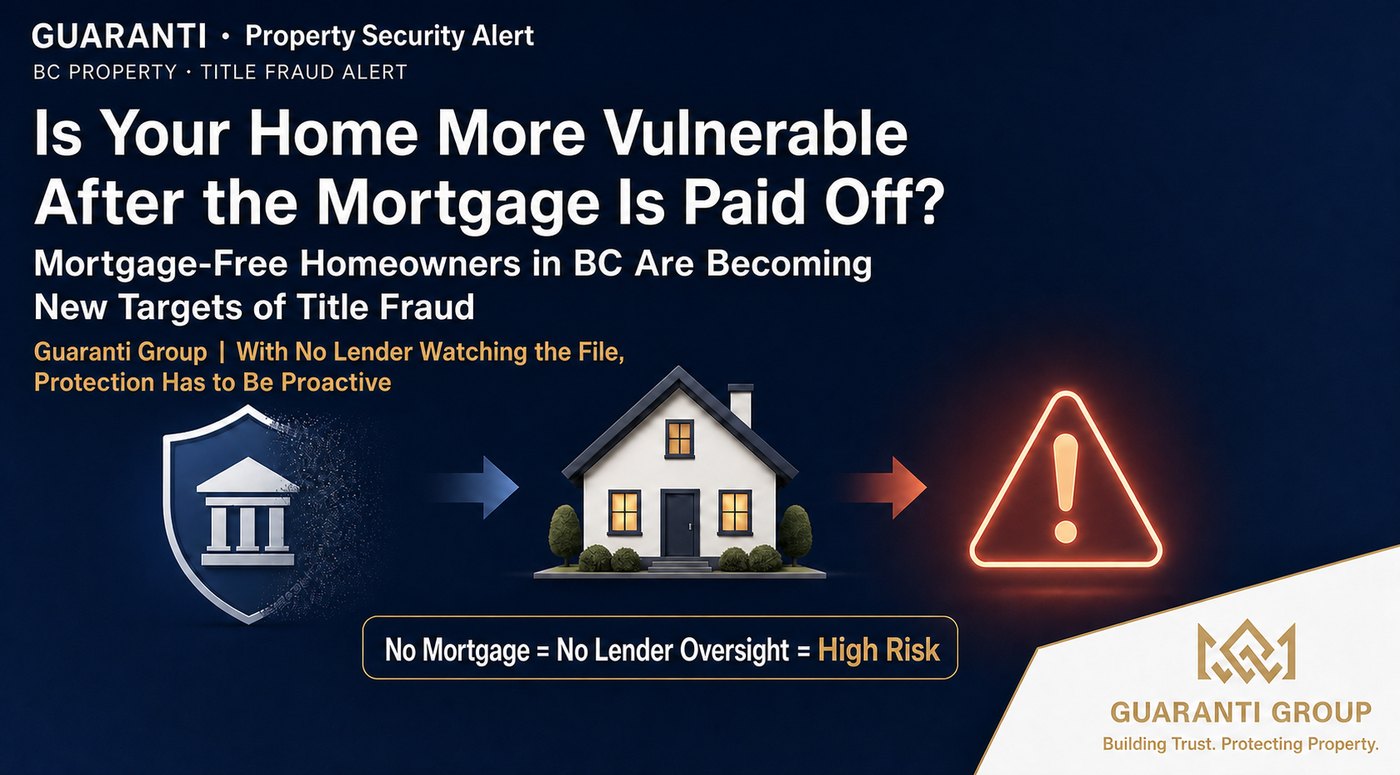
“The mortgage is finally paid off.”
It’s a genuine milestone. No more monthly withdrawal, the house is unambiguously yours, the title is clean.
What most owners don’t consider is that clearing the mortgage removes a debt — and also removes something else. It removes a lender who was, quietly and continuously, standing guard over the file.
In BC, a growing number of title fraud cases point in an uncomfortable direction. Fraudsters aren’t necessarily targeting owners who are struggling to pay. They’re targeting properties with high value, no mortgage, and a registration that hasn’t changed in years.
Because when that kind of property is impersonated, one important checkpoint is missing from the process: the lender.
Paying off a mortgage isn’t the end of risk. It’s the beginning of a different kind. For many families the question worth asking isn’t whether the house has appreciated — it’s whether anyone else has taken an interest in the title.
Two BC cases worth knowing about
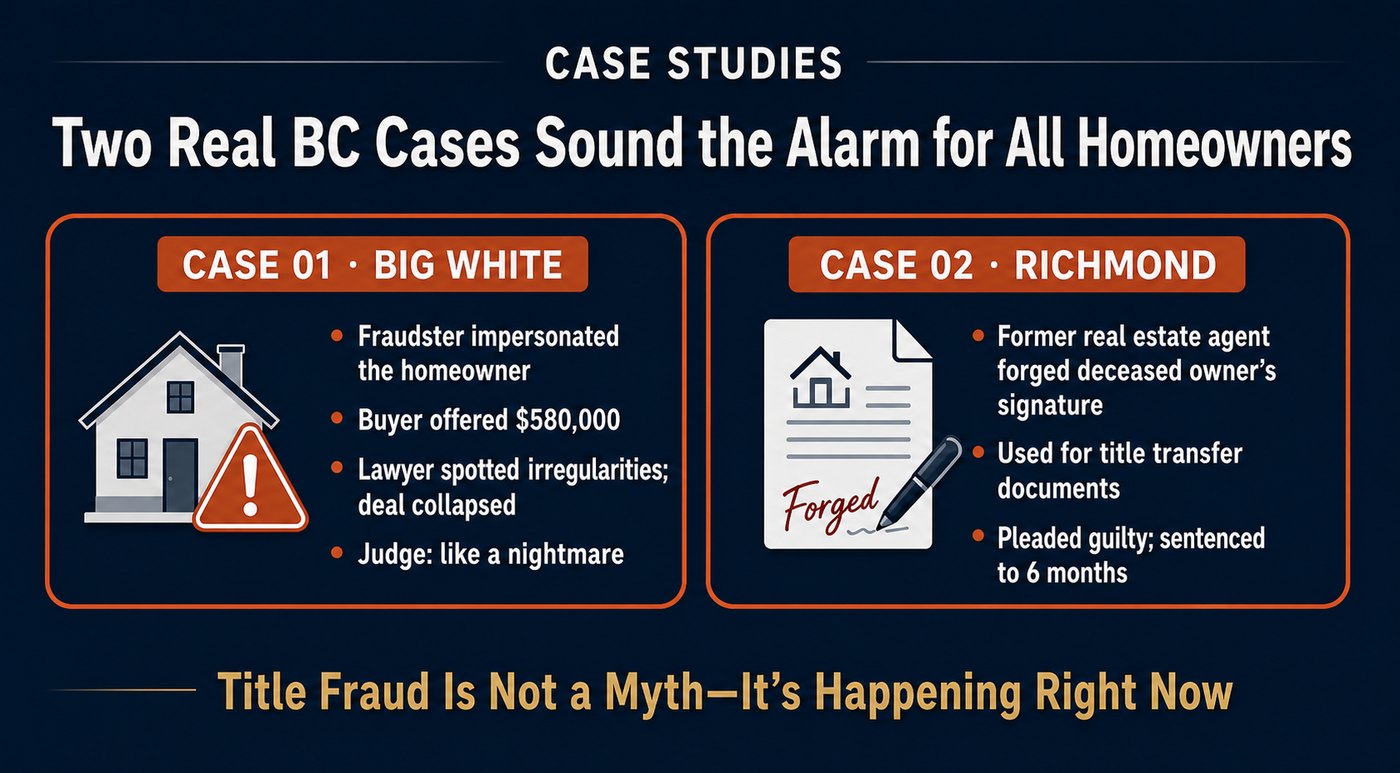
Big White. A couple planning to sell a condominium were in contact with a real estate agent. Fraudsters impersonating the owners inserted themselves into the transaction. A buyer offered $580,000 for the three-bedroom unit, and the deal progressed toward closing — the buyer had already sold their own home and was preparing to move in.
At the last stage the lawyer handling the transfer could not verify the seller’s identity, withdrew, and the entire transaction collapsed. The real owners discovered their identities had been used; the buyer was left with substantial financial and personal loss. The court ultimately found the agent had not been negligent by the standards of the day, but the judge described the episode as a nightmare — and the victims as entirely innocent bystanders.
Richmond. A former Richmond real estate agent admitted to forging the signature of a deceased man on property transfer documents, and received a six-month conditional sentence, the first four months under house arrest.
Different facts, same lesson. The most dangerous moment in a property transaction is rarely the price negotiation. It’s the moment identity, title and documents are used incorrectly — and in the second case, the fraud came from inside a family and estate situation, not from a stranger.
Why mortgage-free properties attract attention
The obvious objection: surely paying off the mortgage makes a property safer?
When a mortgage exists, the lender’s interest is registered against title. Any transfer, refinancing, discharge or change involves the bank, the bank’s lawyers, loan documents and a funds settlement. It’s cumbersome — and that friction is itself a layer of scrutiny.
Without a mortgage, there’s no charge registered. The title looks cleaner, and the transaction is easier to dress up as a straightforward sale or transfer.
From a fraudster’s point of view there are three attractions.
The value is high. Many long-time Metro Vancouver owners bought decades ago at modest cost and now hold properties worth well over a million dollars.
The ownership looks simple. No mortgage, no charge, no bank involved — so forged identity or documents face fewer external checks.
The owner may not be watching. Retired owners, overseas owners and families holding property long-term rarely search their own title or monitor the land registry for unusual filings.
Which is the point. A mortgage-free property isn’t risk-free. The shape of the risk has changed. You used to worry about the monthly payment. Now the thing worth attention is title security.
BC’s land registry is strong — but it isn’t a reason to stop paying attention
To be fair to the system: BC’s land title registry is among the most mature in the world. The LTSA says as much, and maintains an Assurance Fund that can compensate owners who suffer financial loss from registration error or title fraud in rare cases. The LTSA also states plainly that title fraud in BC is extremely rare.
Extremely rare is not impossible.
More to the point, even where a legal remedy eventually succeeds, the process can be brutal — legal fees, litigation timelines, stress, disrupted family arrangements. And both buyer and seller can end up as innocent casualties.
Title security isn’t something you address after the event. It’s a line you draw beforehand.
The defence most owners have never heard of
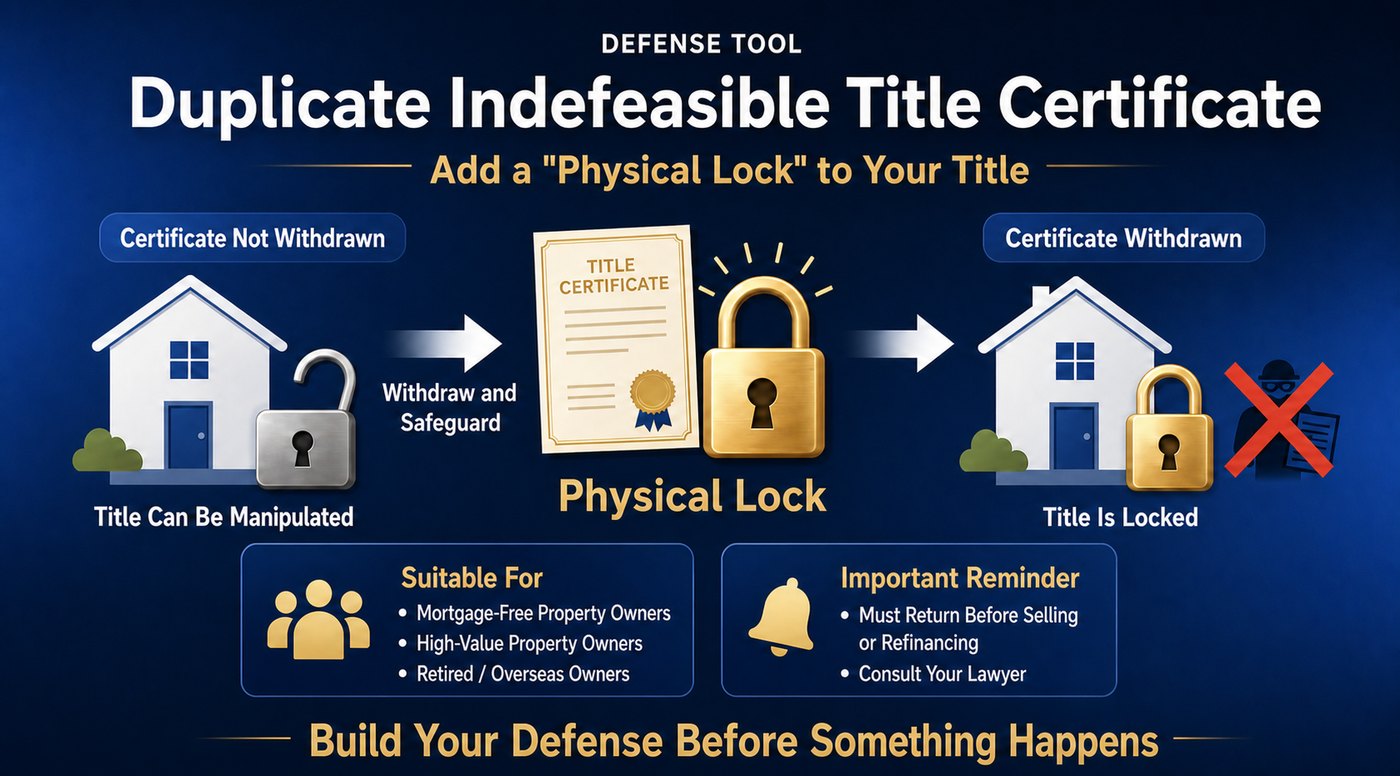
BC has a tool that few ordinary owners know about and that matters specifically to mortgage-free properties: the Duplicate Indefeasible Title Certificate.
The LTSA explains that where there is no current mortgage or agreement for sale registered, an owner may apply to take out a duplicate certificate of title. Once issued, the title generally cannot be transferred and no new mortgage can be registered against it until the certificate is returned to the land title office.
In plain terms: taking out that certificate and storing it securely puts a physical lock on your title. Anyone attempting to file a transfer or mortgage runs into a hard obstacle. Practitioners sometimes describe it as a way of freezing title.
Two cautions, both important. The LTSA emphasises that this is a significant document requiring careful safekeeping — a safety deposit box, not a drawer. If it is lost, replacing it is a complex, time-consuming process requiring a court application.
And it is not right for everyone. If you expect to sell, refinance, apply for a HELOC, or make changes to title in the foreseeable future, holding the certificate will make each of those slower and more complicated. It suits owners who intend to hold, not transact. Speak to a lawyer before deciding.
What else owners should be doing
Title security is a set of habits, not a single action.
Search your own title, once a year. A lawyer or notary can obtain a State of Title Certificate for you at modest cost — worth adding to an annual financial review. The LTSA notes that a State of Title Certificate sets out the registered owner, the legal description, the PID, and any charges, liens and interests registered against the property. Check that the owner’s name, mortgages, charges, liens and easements all look as they should.
Consider title monitoring. The LTSA notes that monitoring services can alert a legal professional by email when an application that may affect your title is filed, and that it is working toward making self-monitoring easier for owners.
Protect your identity documents. The entry point for property fraud is usually not the house — it’s identity theft. Passports, driver’s licences, tax correspondence, property tax and vacancy tax filings, bank mail: all of it is raw material for someone assembling a plausible identity.
Be careful with remote transactions. Any high-value property transaction conducted entirely by email, text or WhatsApp warrants additional caution. A sudden change of email address, a change of receiving account, a refusal to verify identity by video, or pressure to sign quickly — each is a reason to stop and confirm through a channel you initiated.
Pay particular attention to elderly owners, overseas owners and vacant properties. If an elderly parent owns a mortgage-free home, adult children should help confirm the title status periodically, organise the important documents, and establish standing contact with a lawyer, notary and mortgage advisor.
Paid off doesn’t mean finished
Many families hold a traditional and entirely reasonable belief: once the mortgage is cleared, the hard part is over. No debt to the bank means the asset is safe. Put the title documents away and that’s that.
Current conditions suggest a different framing. Property security is no longer a question of whether there’s a mortgage. It’s a question of whether anyone is still managing the asset.
Worth checking:
- Are there any unusual registrations against title?
- Is there any exposure from misused identity documents?
- Is this property a candidate for a Duplicate Indefeasible Title Certificate?
- Are refinancing, succession, adding a name, or a sale likely in future?
- If the owner is elderly, are the power of attorney, will and representation agreement all in place?
These are legal questions. They’re also family wealth questions, and they don’t sit neatly in either category.
A closing thought
Paying off a mortgage represents decades of work. It deserves to be celebrated — and protected.
But a house with no mortgage is not a house with no risk. Without a lender’s charge on title, the responsibility for building that line of defence falls to you.
What fraudsters look for isn’t a complicated property. It’s a valuable one, with clean title, owned by someone who hasn’t looked in years.
For any mortgage-free owner — particularly retired owners, overseas owners, and owners of high-value property — a title check is worth doing soon: search the title, confirm there are no unusual registrations, ask a lawyer whether a Duplicate Indefeasible Title Certificate makes sense, and review the property alongside your estate documents, powers of attorney and financing plans.
Clearing the mortgage is the first step. The peace of mind comes from knowing the house is not only yours, but properly protected.
This article is general information, not legal advice. Case details are drawn from public reporting and LTSA published material. Whether any particular measure suits your circumstances should be confirmed with a BC lawyer or notary.
First published on Guaranti’s WeChat account.