
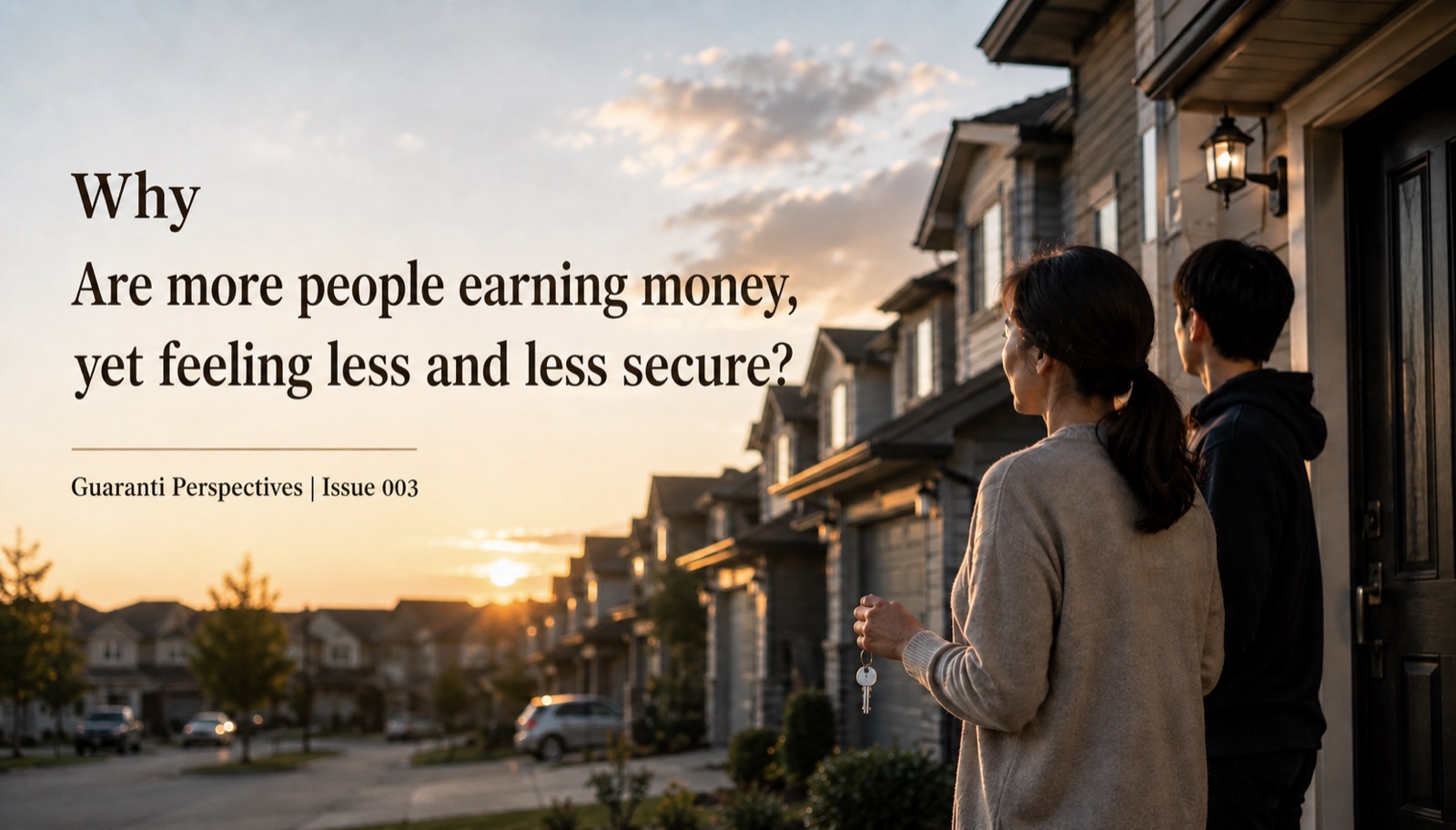
A client came in the other day.
She emigrated to Canada three years ago. Her child was still at university then, and the family had been renting ever since. She worked hard; her child graduated. This year, she finally decided to buy — a townhouse.
When the paperwork was signed, I said to her, smiling: “Congratulations. A home of your own at last.”
She smiled too. Then, a moment later, she said something else:
“Honestly, I still don’t feel secure.”

What worried her was not today
It stopped me. By most measures she had arrived at the life a great many people are working towards — she had emigrated, her child had graduated, she had bought a home. Everything was slowly getting better.
And yet: “I don’t know whether I’ll stay in Canada.” “And I don’t know whether the way I’ve arranged things now is the right fit for what comes next.”
That was the moment it landed. What worried her was not today. It was the future.
We have had this conversation many times
The more I thought about it, the more I realised how often we have this conversation.
Someone with a stable career and good income, worried about where their industry is heading. Someone who owns several properties, worried about rates and cash flow. Someone starting to plan for retirement, with no clear picture of what the next twenty years look like.
Different lives, different incomes, different ages. And at the end, more or less the same question:
“If the future changes, is what I’ve set up still enough?”
What changes us is not wealth. It is uncertainty.
I used to think security came from having more. It doesn’t.
Twenty years ago, the arc of a household’s life was largely foreseeable: work hard, buy a home, raise the children, retire. Put in the effort and most of it seemed to follow, step by step.
And today? Work can be redrawn by technology. Industries adjust with the market. Rates rise and fall. Policy changes. Where a child will build their life, nobody knows — and whether we ourselves will still be in the same city in five years is not something anyone can promise.
The future has never held this much change. Which is why more and more people are arriving at the same conclusion: what leaves you feeling unsafe is not earning too little. It is that the future has become harder to predict.
Security was never a number
What is interesting is that over these years we have sat with a great many households — recent graduates, founders, business owners, people already retired. Incomes from tens of thousands to several hundred thousand and beyond.
Security and income are not the same line. Some people on ordinary incomes live with real steadiness. Some people with successful careers still don’t sleep well.
Why?
Because security was never a number. It is a footing from which to face what comes. Not how much sits in the account, but whether you are prepared for the day life changes.
These questions have no standard answer, but they are worth sitting with:
- If income stopped tomorrow, how long could the household hold?
- If a parent needed care, would we have the time — and the means?
- If a child wants more options in future, have we started preparing today?
- If something unexpected happens, is there room left to protect what we already have?
What is it we actually want
We spend a great deal of time pursuing more — more income, a larger home, more assets — and rarely stop to ask what it is we actually want.
Perhaps what we are after was never the wealth itself, but the ease of being able to meet the future without flinching.
Real security, then, is not that the future won’t change. It is that when it does, we are still able to choose.
The Guaranti view
At Guaranti Group we have come to believe that planning is not about predicting the future — because nobody can.
Real planning is what leaves a family with choices when things change.
The future will change, and life rarely runs to plan. But a little more preparation today buys a little more composure tomorrow.
What actually settles people is not the figure in the account. It is knowing that whatever happens, they can still look after themselves — and the people around them.
Upcoming seminar · Cantonese session

Bought a Pre-Construction? Close, Assign, or Walk Away?
Speakers: Elvis Hui (Mortgage) × Vivian Chung (Legal) × Jeanie Ho (Real Estate)
Date: Wednesday, 19 August Time: 10:30 AM – 12:00 PM Address: Unit 635-640, 5599 No.3 Road, Richmond, BC
This session is conducted in Cantonese.
First published on Guaranti’s WeChat account.