
Most owners buy home insurance believing they’ve bought peace of mind.
House catches fire — insured. Pipe bursts — insured. Guest slips and falls — insured. House is rented out — presumably also insured?
That last one is where the trouble sits. Most home policies are not a promise to pay whenever something goes wrong with the house. They rest on a premise: that the insurer knows how the property is being used.
If the use changes and the insurer doesn’t know, the risk has changed too.
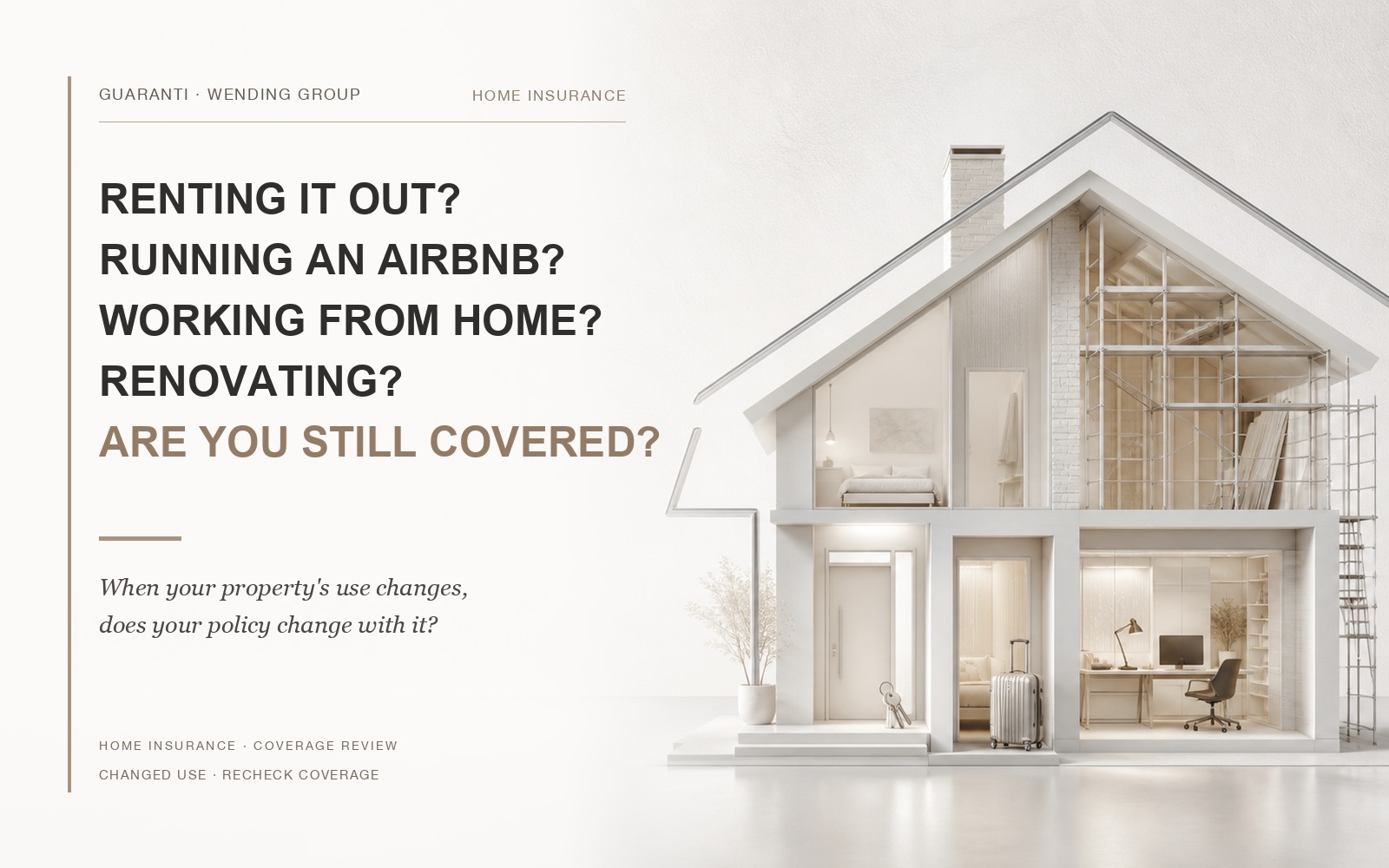
You rented out your principal residence. You started short-term rentals. You began running a business from home. You’re partway through a major renovation. The basement is now a suite.
To you these are lifestyle changes. To an insurer they may be an entirely different risk profile.
Which is why the Insurance Bureau of Canada advises owners planning to rent out a principal or secondary property — long-term or short-term — to contact their insurer first, and warns that failing to give notice can invalidate coverage.
The real exposure for most owners isn’t going without insurance. It’s holding a policy that no longer matches the house. The property changed; the policy stayed where it was.
Insurance doesn’t fear damage. It fears an unreported change of use.
People think of home insurance as protecting the building.
From the insurer’s side, a principal residence, a long-term rental, a short-term rental and a house under renovation are four different risks.
Owner-occupied — the insurer is pricing the risk of you and your family living there day to day.
Long-term rental — the risk becomes tenant use, third-party liability, loss of rental income, landlord obligations.
Short-term rental — the risk becomes frequent strangers, parties, damage, accidental injury.
Working from home — the risk may extend to client visits, equipment, commercial liability.
Renovation — the risk includes construction, trades, materials, vacancy, structural change.
Same house. Change how it’s used and the underwriting logic changes with it.
Not telling your insurer doesn’t mean the risk didn’t occur. It means the question gets asked at the worst possible moment — when a claim is filed and the insurer wants to know how the property was actually being used.
The devastating part isn’t the loss itself. It’s discovering that the coverage you assumed you had may not apply.
Renting it out — is the policy still good?
If you bought an owner-occupied policy and later rented the whole property, or rooms within it, this deserves careful attention.
A long-term rental is not the same risk as living there. The occupant isn’t the owner. Frequency of use, responsibility for maintenance and third-party liability all shift. The IBC is explicit that owners planning to rent a principal or secondary property, long or short-term, should contact their insurer first — and that not doing so may void coverage.
This is not a rule that renting is uninsurable. It’s a rule that the insurer has to know, so coverage can be matched to actual use.
The most common assumptions we hear:
It’s only the basement. — It’s only for a few months. — I know the tenant well. — I’ve paid the premium every year, of course I’m covered.
Insurance doesn’t operate on reasonableness. It operates on the terms of the policy. If the use has moved from owner-occupied to tenanted and the policy hasn’t been updated, then a fire, water damage, tenant injury or third-party claim becomes a far more complicated conversation than it should be.
Short-term rental is a different animal again
Short-term is more sensitive than long-term, because the defining risk is turnover: occupants change constantly, use is less controllable, and much of the time the property is being used intensively by strangers for brief periods.
The IBC’s guidance on short-term rentals stresses contacting your insurer to confirm coverage before listing, and telling your representative about any change in how the home or secondary property is used.
Which means that if you’re already hosting, or about to list, the first step isn’t photographs, pricing and going live. It’s asking:
- Does my current policy permit short-term rental at all?
- How many days a year?
- Do I need a separate short-term rental policy?
- Is damage caused by guests covered?
- Is guest injury on the property covered?
- How does the platform’s protection interact with my own policy?
- If there’s water damage, a fire, or a third-party claim — who responds?
The bigger risk in short-term rental isn’t a guest damaging the house. It’s an owner assuming platform protection substitutes for their own insurance. Platform coverage is typically conditional, capped, and not necessarily aligned with what a host actually needs covered.
Working from home can change the risk too
Home working became normal for a lot of people, and much of it changes very little — sitting at a desk with a laptop is not a material shift.
But some people are running a business from home: aesthetics, nails, consulting, e-commerce inventory, a photography studio, tutoring, physiotherapy. Sometimes with clients coming to the house.
That is no longer simply working from home. It may be commercial use of a residential property.
If a client is injured on your property, if commercial equipment, inventory or samples are damaged, or if a business activity generates a third-party claim, a standard home policy may not respond the way you’d expect.
So once your home is partly doing a commercial job, the policy is worth re-examining. You may not need a complex commercial policy — but you should confirm whether the existing one permits the activity, whether an endorsement is required, and whether separate commercial liability makes sense.
Renovation is its own exposure
Owners renovating tend to focus on budget, design and schedule. Insurance rarely makes the list.
To an insurer, renovation means elevated risk: fire, plumbing, electrical, worker injury, structural change. If the property sits vacant during the work, the risk changes again.
For substantial work — removing walls, adding to the structure, changing use, adding a kitchen or a rental suite — advance notice matters. Many policies carry specific conditions around vacancy, major renovation and structural alteration. Without notice, a claim becomes contestable.
Three things to do before work begins. Tell your insurer the scope of what you’re doing. Confirm your contractor carries their own liability insurance and workers’ compensation coverage. Confirm your policy remains in force during the work and whether a temporary adjustment is needed.

Who should be reviewing their policy
Condo owners. Townhouse owners. Detached homeowners in particular. Anyone renting a property out. Anyone hosting on a short-term platform or considering it. Anyone working from home or running a small business there. Anyone planning to renovate, add on, or build out a basement suite.
And anyone who simply hasn’t read their home policy carefully in some years.
The house is the largest asset most families hold. Insurance isn’t there to look reassuring in ordinary times. It’s there to work when something actually happens.
A closing thought
The difficult part of insurance is rarely the purchase. It’s the claim.
You thought you’d just rented the place out. Just hosted a few nights. Just started working from home. Just done some renovations.
To an insurer, every one of those may be a change of use.
Don’t wait for the burst pipe, the injured guest or the fire to discover the policy may not respond. When the use of the property changes, the insurance has to change with it.

Poster for the 10 June 2026 session. It was held in Mandarin, so the poster is in Chinese only.
This article is general information, not insurance advice. Policy wordings and conditions differ between insurers — confirm your own coverage with your broker or insurer.
First published on Guaranti’s WeChat account.