
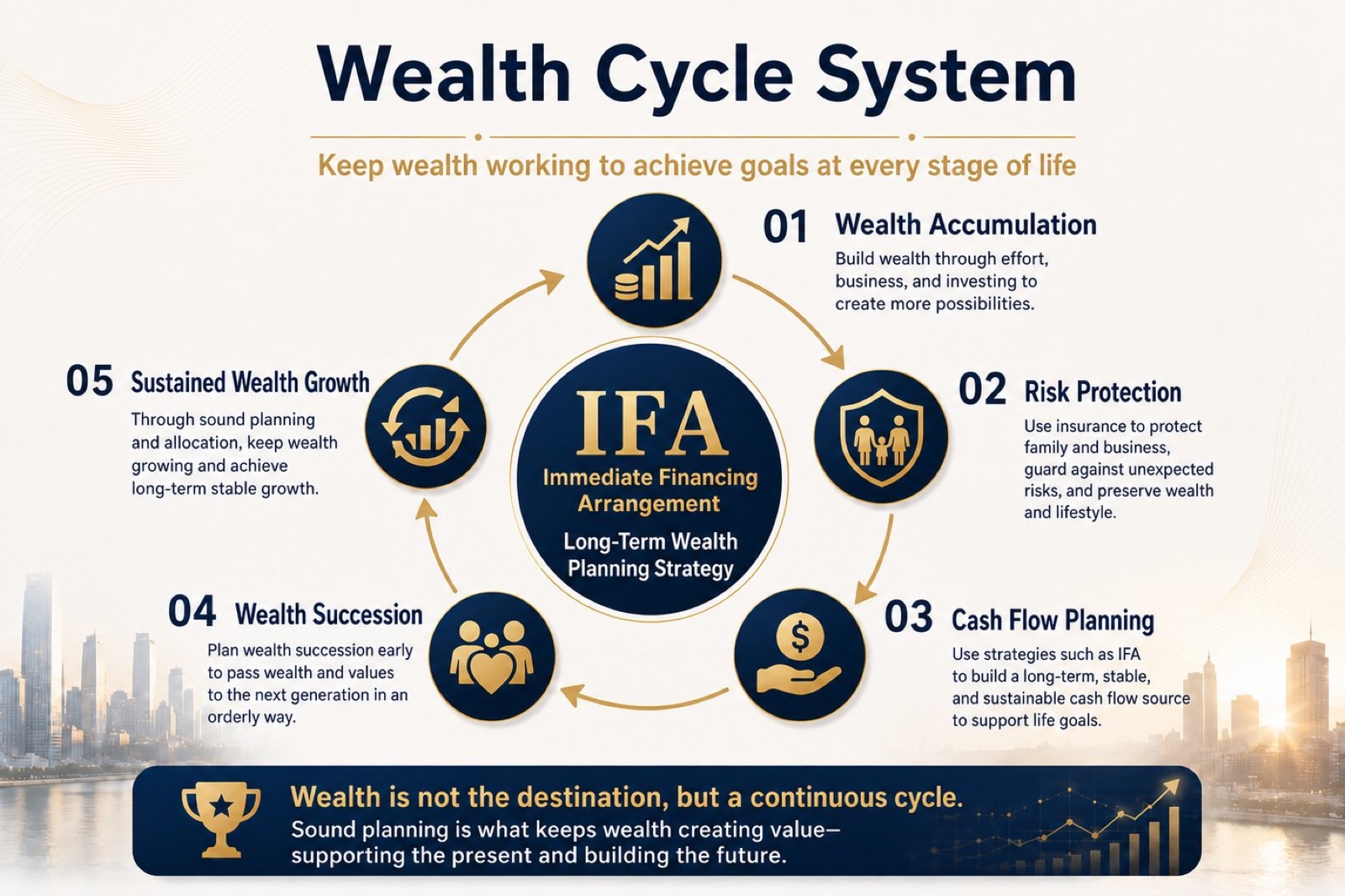
Last issue we looked at why more families are asking about the Immediate Financing Arrangement (IFA). The question that follows is always the same:
What does it actually give me?
It is worth saying clearly what an IFA is not built for. It is not a way to chase a return. It is a long-term structure, and what it is trying to improve is how efficiently capital moves between four things that usually compete with each other — protection, financing, cash flow, and succession.
One — capital that isn’t stuck
For most families with substantial assets, the constraint isn’t a shortage of money. It’s that money committed to one purpose stops being available for anything else.
The conventional view is that buying insurance locks capital away. An IFA approaches it differently: the policy builds long-term protection, and — where the circumstances qualify — a financing arrangement keeps capital available for the business, for investment, or for whatever else the plan calls for.
Put simply: the same capital carries more than one role.
Two — protection without giving up liquidity
Almost every family runs into the same trade-off. They want protection in place. They don’t want to tie up cash flow to get it.
That is the tension an IFA is designed around. For families who qualify, it aims to establish long-term protection while leaving capital usable.
Protection and liquidity are not always an either/or.
Three — a structure that lasts longer than a decision
Planning is not a snapshot of what you own today. The real question is what your wealth is doing ten, twenty, thirty years from now.
An IFA is deliberately long-horizon. It moves a family from managing money year to year toward a structure that keeps supporting the same goals as circumstances change.
Four — succession, prepared early rather than late
For most families, wealth isn’t only theirs. It carries obligations to the people who come after.
Which is why the questions arrive earlier than they used to. How does this pass on in an orderly way? How do we reduce what’s left uncertain? What actually reaches the next generation?
An IFA is often one component of the answer.
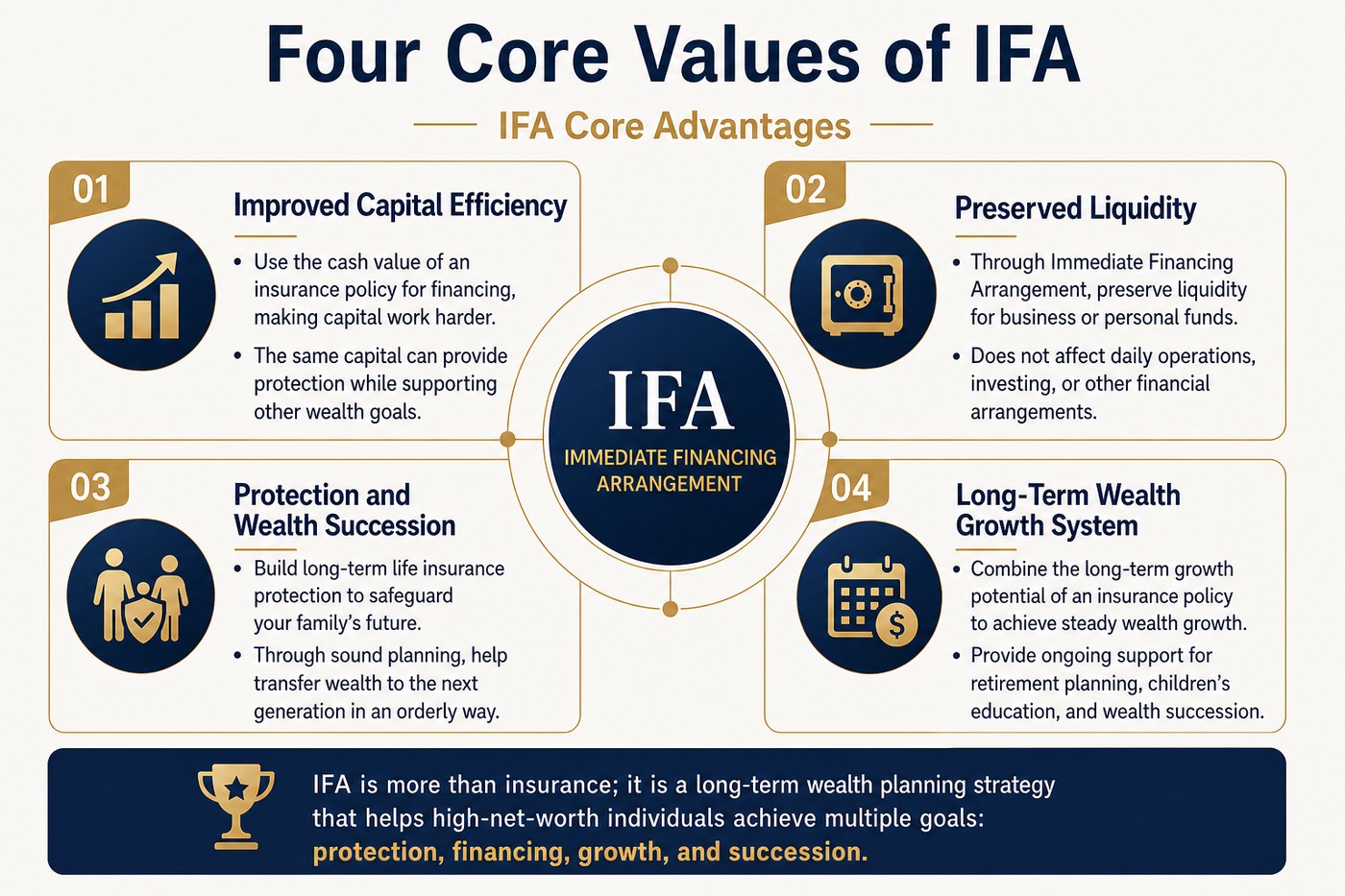
What the structure is really about
People tend to fixate on the financing piece. The more interesting part is the thinking behind it — what the arrangement is trying to achieve:
- Capital that works harder
- Liquidity preserved
- A structure that holds up over decades
- Protection for the family
- Succession prepared in advance
Financing is a tool used to get there. It was never the point.

Our view
Planning has never been about finding the single best product.
It is about building a structure that suits the stage of life you are actually in — and being willing to revise it when that stage changes.
Good planning doesn’t leave wealth sitting in the present. It keeps wealth useful into a future you can’t fully predict.
Worth sitting with
If you had one pool of capital — would you want it to do one job, or to protect your family while also forming part of what comes next?
The structure you choose changes the answer.

Poster for the 17 July 2026 session. It was held in Mandarin, so the poster is in Chinese only.
This article is general information, not advice. Whether any structure suits your situation depends on facts we would need to review with you and your accounting and legal advisors.
First published on Guaranti’s WeChat account.