
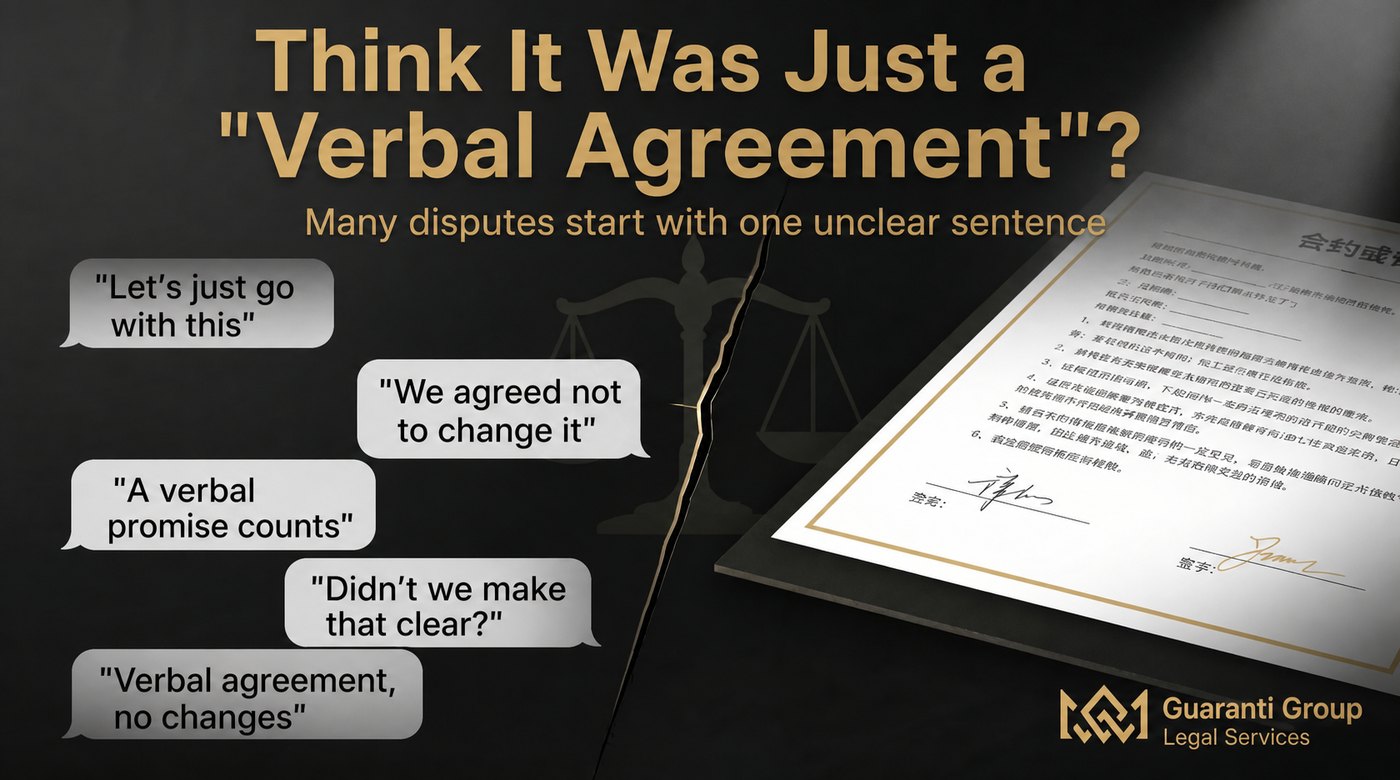
Most people assume that ordinary arrangements only need to be talked through.
Renting a place. A renovation. A business arrangement. Lending money. Helping out family. At the time it seems settled — someone says “sure”, someone replies “no problem” on WeChat, and both parties walk away believing the matter is agreed.
But most disputes don’t begin with anyone intending to deceive, and rarely with anyone trying to take advantage. The pattern is narrower than that:
You believe you were clear. They believe they understood. And the two of you take completely different meanings from the same sentence.
By the time things have moved forward — money spent, work done, someone living in the property — going back to establish what was actually meant is close to impossible.
A real case: the tenant moved in before she owned the house
Chantal Wang, a lawyer we work with, handled a case that illustrates this precisely.
A client had signed a purchase contract but had not yet completed. She had bought the property; she was not yet the registered owner.
The property manager contacted her: a family wanted to rent the place early. She had intended to rent it out eventually, so the request seemed reasonable. She agreed. The tenants moved in before she legally owned the home.
She thought: an early tenancy helps with the eventual rental. The tenants thought: consent has been given, so we can set the place up as we need it. The property manager thought: both sides are willing, this should go smoothly.
That is where the problem started.
“Some renovation is fine” was heard as “renovate as you like”
After moving in, the tenants began renovating. The client had said she was “fine with some renovation.”
An unremarkable sentence. The difficulty is what it means.
What does some renovation include? Painting? Light fixtures? Flooring? Repairs? Or removing walls, changing the layout, altering the floor plan?
Her intention was limited, reasonable work that wouldn’t affect structure or layout. The tenants read consent to some renovation as authorisation for a full remodel — and proceeded to make substantial changes, including significant alterations to the floor plan.
She was stunned: when did I agree to this? They felt wronged: you said renovation was fine.
A simple early-tenancy arrangement had become a complicated dispute.
The issue isn’t the renovation. It’s the absence of a clear agreement.
Legally, the question isn’t who has more sympathy. It’s whether the parties ever formed a clear, complete, enforceable agreement.
An enforceable contract usually requires more than I thought that was fine. It requires agreement on the terms that matter:
- What is the scope of the work? What is permitted and what is absolutely not?
- Can the structure or floor plan be altered?
- Who bears the cost?
- Is the owner’s prior written approval required? Are drawings, quotes or a work plan to be submitted?
- What are the start and finish dates? Who inspects on completion?
- If the work causes damage, who is responsible?
Where none of this is written, each party proceeds on their own reading.
You meant painting. They heard demolition. You meant patching. They heard redesign. You meant a temporary move-in. They heard full authority to use and modify.
Legal risk usually hides in the small things
There’s a belief that lawyers belong to large contracts, large transactions, large deals.
In practice, the disputes that cause the most damage tend to grow out of matters that seemed too minor to bother a lawyer with.
- Lending money to a friend without setting a repayment date
- Parents helping a child buy a home, without specifying gift or loan
- A tenant moving in early, with no agreement on responsibility or authority
- Going into business together, agreeing the split but not the exit
- Allowing someone to use or alter a property before title transfers
At the outset the mood is good, everyone trusts everyone, and putting it in writing feels cold. When these go wrong, they hurt more than commercial disputes — because each side genuinely believes they’re in the right, and each believes the other broke what was agreed.
One confirming email can prevent the whole thing
Chantal’s client reflected afterwards that a short conversation with a lawyer beforehand would have avoided nearly all of it.
Preventing a dispute rarely requires an elaborate legal document. Sometimes a clear written agreement is enough. Sometimes a confirming email is enough. Sometimes it’s just a lawyer saying this part should be written down.
In this case, setting out at the start:
- Whether the tenants could move in early, and who carried responsibility during that period
- Whether renovation was permitted, and exactly which items were within scope
- That all work required the owner’s prior written approval, with no changes to structure, layout or floor plan
- That any unapproved alteration had to be restored at the tenants’ cost
would very likely have prevented what followed.
A legal document doesn’t make a relationship colder. It makes it clearer — and clarity is what protects both sides.
What a lawyer is actually for
Most people associate lawyers with litigation — as though you call one only after things have escalated, the relationship has broken down and the loss has happened.
The larger part of the value comes earlier: seeing the risk before it materialises.
A lawyer doing this properly doesn’t only answer can I sign this? They think one step further:
- Is this sentence ambiguous? Could the other side read it differently?
- Does this arrangement leave any evidence behind?
- If things don’t go to plan, who carries the responsibility?
- If there’s a dispute later, can you prove what was agreed?
Because the expensive thing is rarely the legal fee. It’s the cost of the misunderstanding.

Every family could use a lawyer for everyday decisions
Families insure the car, the house and their health. They plan for education, retirement and their assets. What often gets overlooked is that important everyday decisions need legal protection too.
Not a lawyer for divorce or family litigation — a legal advisor willing to check things before you commit at the moments that matter:
- Reading the terms that matter when buying or selling
- Explaining the real exposure in a mortgage or guarantee document
- Raising the lease, deposit, liability and insurance questions before you rent a property out
- Confirming the contract, payment milestones and responsibility before a renovation
- Putting the repayment terms in writing when lending to family or friends
- Setting out rights and obligations before a business arrangement
Most of these are solvable — until the moment for prevention passes
Once the renovation is finished, arguing about authorisation is expensive. Once the money has gone out, papering a loan agreement is difficult. Once someone is living in the property, discussing the boundaries of responsibility invites conflict. Once the contract is signed, saying you didn’t understand it is usually too late.
Sound legal arrangement isn’t remedial. It’s asking one question before anything begins: is there anything here that should be written down?
A closing thought
Legal risk feels remote. In practice it sits inside the most ordinary decisions we make.
A verbal yes. An early move-in. A loan to a friend. A renovation arrangement. A contract skimmed rather than read. A promise never written down.
Most disputes aren’t born of bad faith — they’re born of misunderstanding. Most losses don’t come from complex transactions — they come from something that was never made clear at the start.
Don’t wait until the problem arrives to discover that a simple agreement, a confirming email, or one professional conversation would have prevented it.
If you’re dealing with a purchase or sale, a tenancy, a renovation, a loan or guarantee, family assets, or a business arrangement — anything you’d describe as probably fine — it’s worth raising beforehand. Getting it in writing at the start doesn’t just protect a document. It protects your time, your money, your relationships and your family’s assets.
This article is general information, not legal advice. Case details have been described with identifying particulars removed. Your own circumstances should be reviewed with a qualified BC lawyer.
First published on Guaranti’s WeChat account.