
Only 18 Months of Work in Canada: How Was 80% Financing Secured for a Nearly $900K Investment Property?
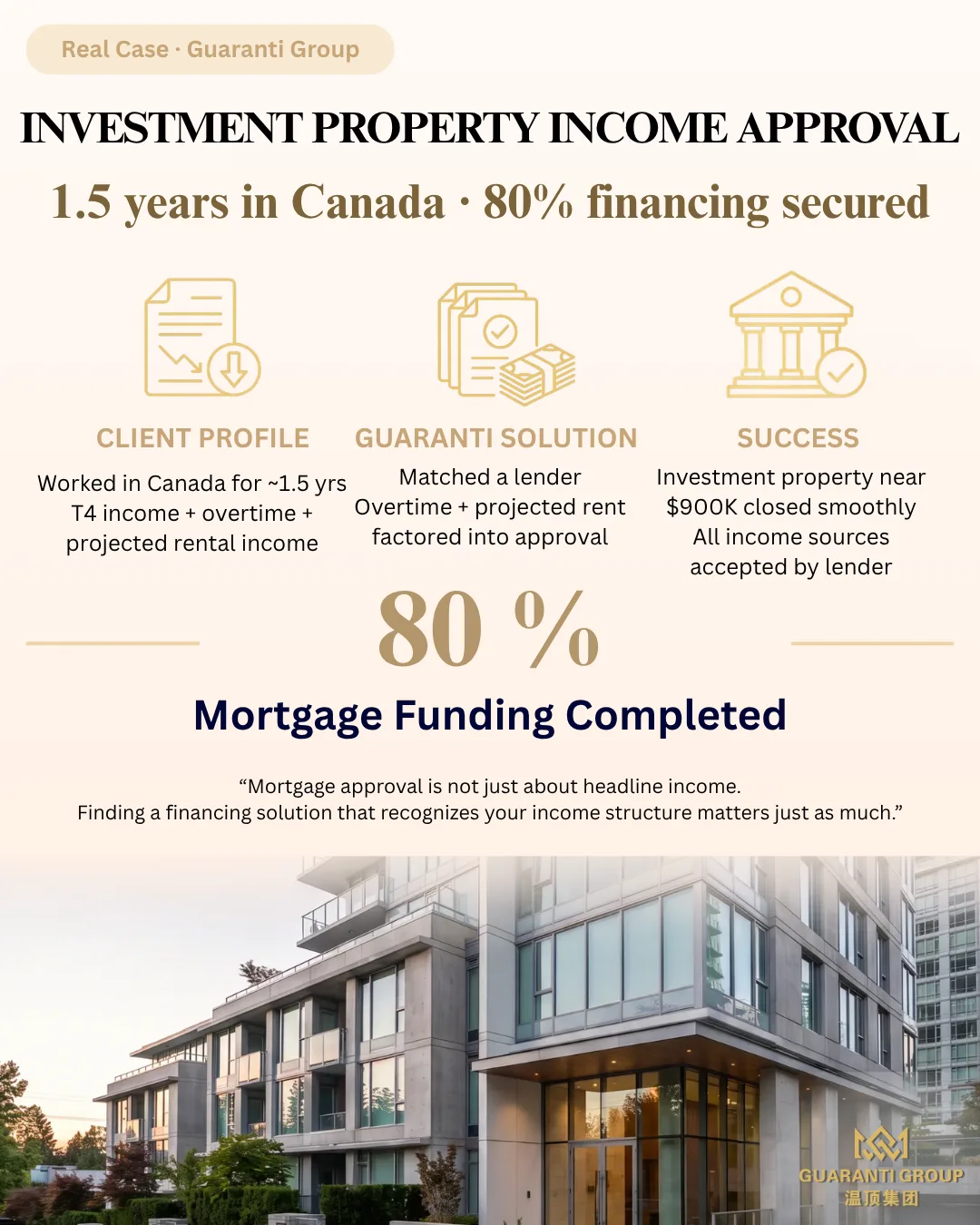
After working in Canada for about a year and a half, the client was preparing to buy an investment property priced at nearly CAD $900,000 and hoped to finance 80% of the purchase.
This is a real mortgage case recently completed by Guaranti Group.
The client had regular employment income as well as overtime pay. The plan was to rent out the entire property, which was expected to generate rental income.
There were several potential income sources. The question for the mortgage application was how much of each source a lender would accept.
With a short employment history, how would overtime be assessed?
The client had T4 records and a history of overtime income, but had worked in Canada for only about 18 months.
Lenders assess overtime differently. Some require a longer earnings history; others may consider the employment situation, income records and supporting documents together. Overtime that an applicant has actually earned is therefore not necessarily counted in the same way by every lender.
The purchase also involved an investment property that would be rented out in full. Depending on a lender’s policy, projected rent may be included when assessing the applicant’s ability to make mortgage payments. How much rent is recognized and how it is calculated also vary by lender.
Matching the financing approach to the full income picture
Guaranti Group reviewed the client’s relatively short Canadian employment history, overtime earnings and projected rent from the new property, then matched the application with a suitable lender.
Ultimately, the bank accepted qualifying overtime and projected rental income in its assessment. The mortgage for the investment property priced at nearly CAD $900,000 was funded at 80% of the purchase price.
For buyers with overtime pay, a shorter employment history or plans to purchase a rental property, mortgage underwriting is not simply a matter of looking at headline income. Understanding how different lenders assess each income source can be just as important as finding financing that fits the applicant’s circumstances.
Note: This case is based on an actual financing experience, with amounts rounded for presentation. Mortgage approval depends on the applicant's financial circumstances, the property and lender policies. This outcome does not indicate that other applicants will receive the same terms.
Cases are anonymized and drawn from real client situations.