
Not a Canadian Tax Resident, but Have Overseas Assets: Could You Qualify for a CAD $500K Mortgage?
Can someone buying a home in Canada obtain a bank mortgage if they are not a Canadian tax resident and their assets are spread across several countries or regions?
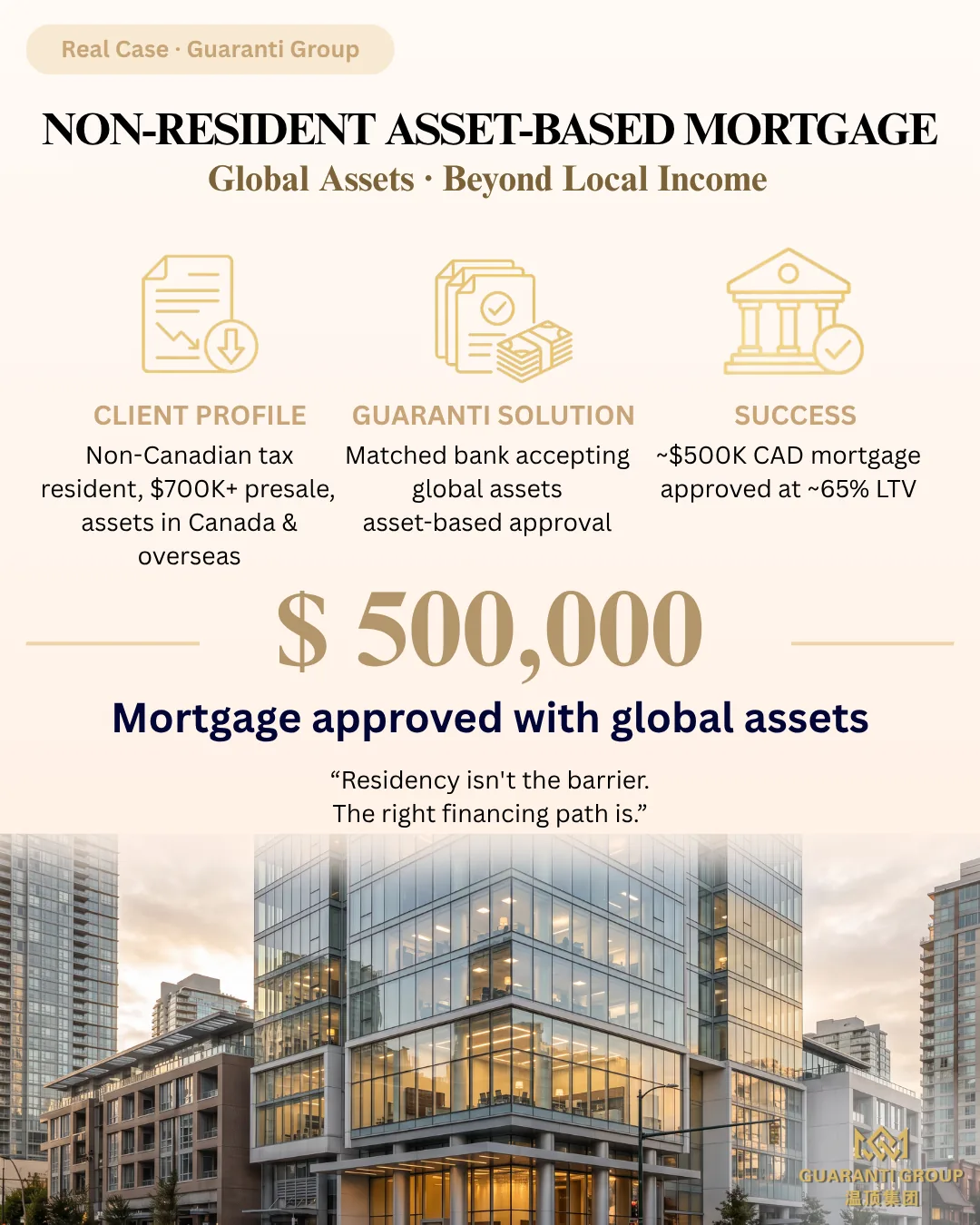
Guaranti Group recently helped a client with assets in Canada and overseas obtain mortgage approval.
How can a buyer with assets apply for a mortgage?
The client was purchasing a presale property in Greater Vancouver for more than CAD $700,000. As completion approached, arranging financing became the immediate priority.
The client was not a Canadian tax resident and held assets both locally and overseas. Unlike a salaried applicant who primarily relies on employment income, this client’s financial strength was more apparent in existing assets.
Lenders do not all assess such applications in the same way. Finding one whose criteria could recognize the client’s asset position was central to the financing plan.
Matching the application to the right lender
In a conventional mortgage review, lenders generally focus on income and debt-service capacity. Some also have assessment approaches for applicants with substantial assets and, subject to their requirements, may place greater weight on documented assets.
After reviewing the client’s circumstances, the Guaranti team identified a bank that could consider assets held in Canada and overseas. We helped organize the asset evidence and other application documents for the lender’s review.
The client ultimately obtained approval for a mortgage of approximately CAD $500,000, equal to about 65% of the property’s purchase price.
For this buyer, the outcome was not simply an approval; it was a financing route aligned with their circumstances that supported the upcoming presale completion.
Can home financing be planned before a move to Canada?
Canada has recently announced a time-limited measure to accelerate processing for certain permanent residence applicants already in Canada. For families already living here and planning their next stage, homeownership may become part of that discussion. This immigration measure is separate from the client’s mortgage approval in this case.
Many cross-border households face a similar financing question: they may have property, savings or investments overseas, but limited Canadian employment income or tax-filing history. Does that leave a path to bank financing?
This case shows that a different financial profile does not necessarily require the same assessment route as a conventional income-based application. Understanding available assets and finding a lender whose criteria fit may provide more options.
A home purchase and its financing both require planning. Whether buying a property or preparing for presale completion, checking purchase eligibility separately from mortgage requirements can help families prepare for what comes next.
Disclaimer: This case is based on an actual mortgage approval. Some details have been anonymized, and amounts are approximate. Approval depends on the applicant's status, income, assets, property and lender policies. Eligibility to purchase property and eligibility for financing must be assessed separately. Approval does not mean funds have been advanced. Other applicants may not receive the same terms or result.
Cases are anonymized and drawn from real client situations.