
Self-Employed with $1.3M in Savings, Yet Unable to Qualify for a $900K Mortgage? An Asset-Based Approval Path
The client had been self-employed and running his own business for many years. He recently found a property priced at about $1.16 million and wanted to apply for a mortgage of approximately $900,000.
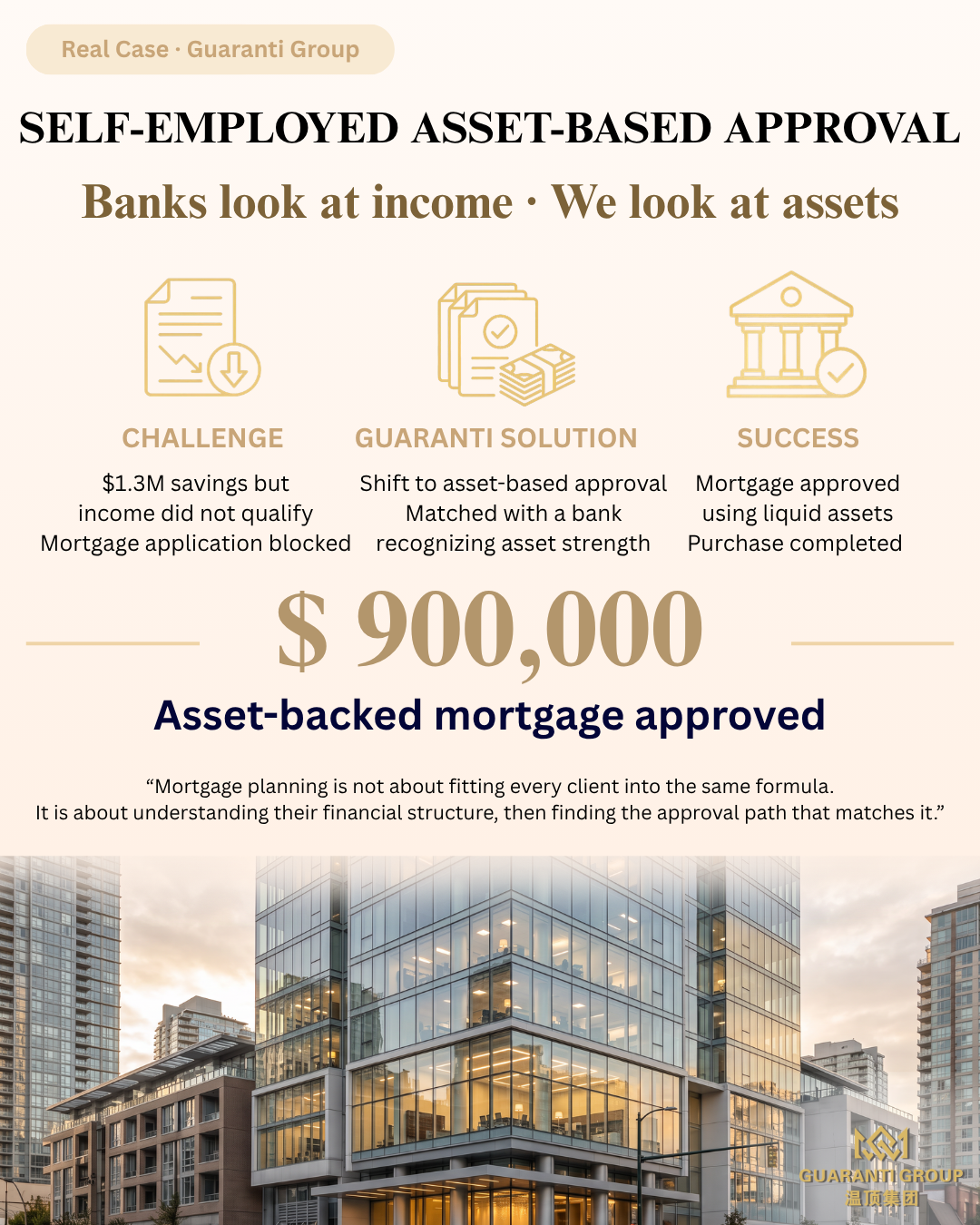
His financial foundation was strong. Over the years, his business had enabled him to build substantial savings, including about $1.3 million in bank deposits held in his own name. When he first applied, he had no reason to think a bank would consider him a difficult borrower.
The obstacle turned out to be income. His personal income as reported for tax purposes was relatively low, and under the original bank’s conventional income assessment, it could not support the requested $900,000 mortgage.
It may seem contradictory: someone with $1.3 million in the bank could not obtain a $900,000 bank mortgage. But underwriting is not simply a question of whether an applicant has money. It is a question of whether the application meets a particular mortgage product’s criteria. Under a traditional income-based review, substantial savings do not necessarily overcome insufficient qualifying income.
After the original bank could not offer a suitable solution, the client contacted Guaranti Group. We reviewed his full situation and shifted the question from how to prove more income to where his real financial strength lay.
Compared with his reported income, the approximately $1.3 million in liquid assets held in his own name was the more significant part of his financial profile. The Guaranti team considered his self-employment, purchase price, financing need and available assets, then compared banks’ underwriting requirements to find one that would recognize that asset position.
We found a bank whose criteria better matched the client’s circumstances. During underwriting, it recognized the approximately $1.3 million in deposits in his own name and included them in its overall assessment. That created a different approval path from one based on reported income alone. The client purchased the approximately $1.16 million property and was approved for a bank mortgage of about $900,000.
The lesson is not simply that a client with $1.3 million in savings obtained a $900,000 mortgage. For many self-employed people, reported personal income does not fully reflect their broader financial position. At the same time, holding assets does not mean every bank or every mortgage product will automatically treat those assets as qualifying capacity.
The important step is to understand the client’s income, assets and financing needs separately, then find underwriting criteria that can recognize the relevant facts. Mortgage planning is not about fitting every applicant into one formula. It is about understanding the financial structure first and finding an appropriate financing path.
When one bank gives an answer, we help clients explore other possibilities.
The rates, amounts and timelines in this story were that client’s actual circumstances at the time. Lending conditions change and every application is assessed on its own merits — these figures are not an indication of what any other applicant will obtain, and are not a promise of any kind.
Cases are anonymized and drawn from real client situations.