
We have generally read the housing market through prices — up or down.
A more consequential question is now surfacing: will Canadians increasingly buy, or increasingly rent?
CREA has revised its market forecast, and BMO’s latest housing analysis identifies a structural shift underneath the numbers: newly built housing is moving away from being sold to individual buyers and toward serving the rental market.
Which suggests the market is entering a different phase, not simply a slower one.
One — CREA trims its forecast: this recovery is slower than expected
On 15 July 2026, the Canadian Real Estate Association released its latest quarterly forecast.
The figures aren’t dramatic. The direction is.
CREA expects roughly 463,336 residential transactions through the MLS® system across 2026 — down 1.4% from 2025.
That number has been revised three times:
- January — growth of 5.1% forecast
- April — revised down to modest growth
- July — full-year volume now forecast to decline 1.4%
Each revision more conservative than the last.
That said, this is not a market in continuous decline. CREA also notes national sales have shown signs of recovery since May, led by Ontario, with BC’s rebound comparatively mild. June sales were up 0.9% year over year and 0.5% month over month.
So: not falling, but recovering slowly and cautiously.
Why was the full year still revised down? Three reasons.
The first half was weak, and it dragged on the annual figure. Buyers were watching, but they didn’t return to the market in volume.
Higher oil prices raised inflation concerns. Fixed mortgage rates jumped at the end of March before easing back, which affected buyer confidence.
Population growth slowed, and support for housing demand in some regions weakened faster than anticipated.
On prices, CREA expects the national average to rise 1.1% in 2026 to $686,710 — a modest enough increase to indicate prices are not breaking upward.
| 2026 forecast | 2027 forecast | |
|---|---|---|
| Transactions | 463,336 (−1.4%) | 480,567 (+3.7%) |
| Average price | $686,710 (+1.1%) | $694,164 (+1.1%) |
Worth noting: Ontario is the only province forecast to see transaction growth in 2026, while prices in BC and Ontario are both expected to slip by slightly under 1%.
Two — BMO: for the first time, over half of new housing is rental
If CREA’s data describes how cold the market is, BMO’s analysis identifies something deeper.
BMO Capital Markets reports that Canada’s problem is not a shortage of new housing supply.
CMHC data shows national housing starts fell 6% in June on a seasonally adjusted annual basis, to 239,000 units — a third consecutive monthly decline.
But look at the stock rather than the flow: roughly 375,000 units are currently under construction nationally, still well above normal levels. Starts have averaged about 256,000 over the past twelve months, which is a reasonably healthy range.
The change isn’t in the volume. It’s in the purpose.
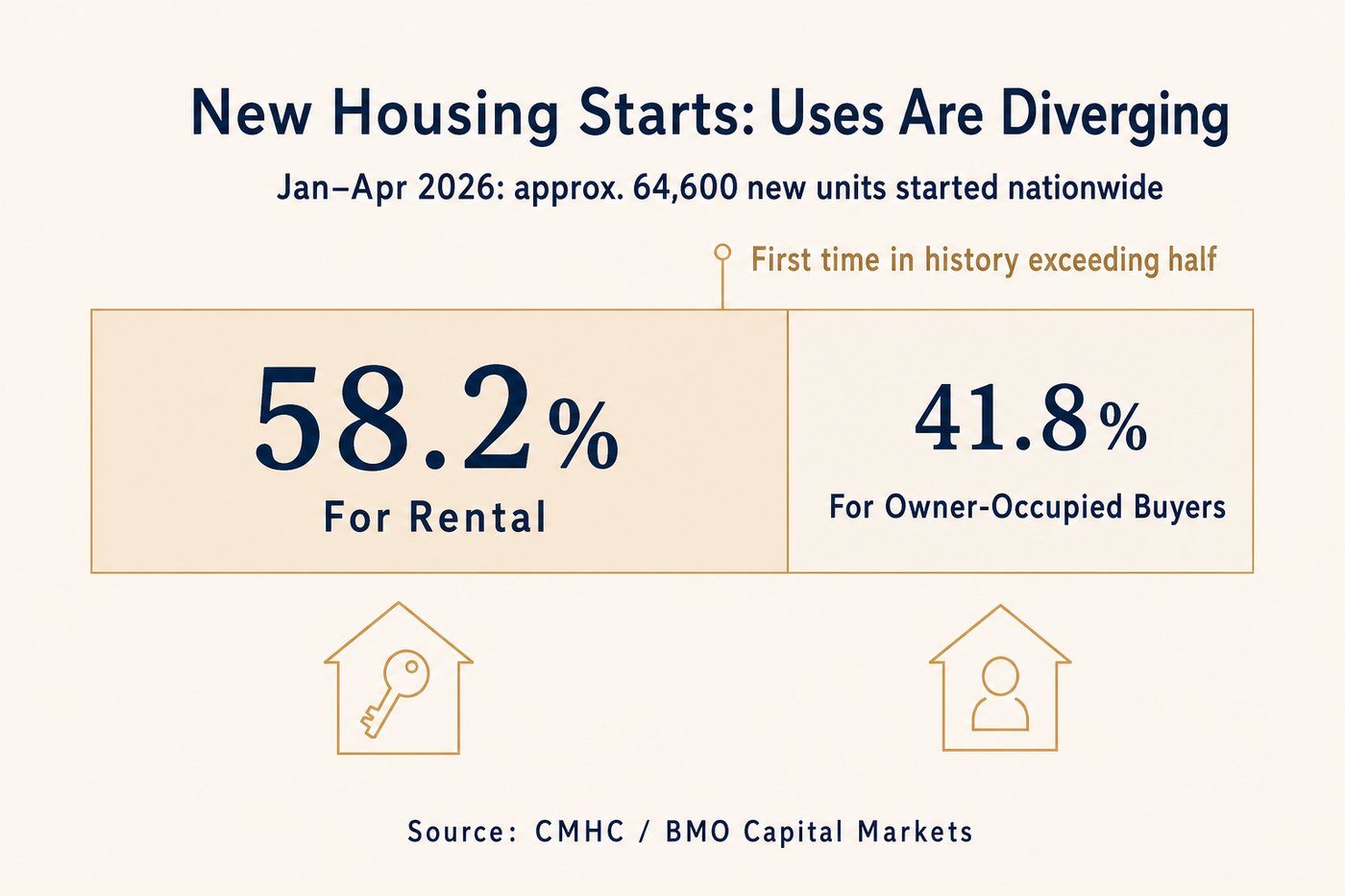
On unadjusted data, roughly 64,600 units were started between January and April 2026, of which about 58.2% were rental.
This is the first time in the history of the Canadian housing market that rental has exceeded housing built for owner-occupiers.
BMO senior economist Robert Kavcic notes that in major metropolitan areas, combined condominium and owner-occupied starts have fallen to their lowest level since the 2009 recession and the mid-1990s downturn — while rental starts remain close to historic highs.
Record lows on one side. Record highs on the other. That is what BMO means by a nation of rentals.
Three — why the shift happened
Kavcic attributes it to the combination of the housing boom, the correction that followed, and the cooling of the presale market.
New-home sales are quiet. Without sufficient presale support, many projects simply cannot break ground.
The rental market has stayed tight. Years of undersupply have made the return profile on rental projects more predictable.
Policy incentives have turned toward rental. Government measures in recent years have actively encouraged rental construction, shifting the market’s focus from individual buyers toward investors and institutions.
Together these have changed how developers decide what to build. They used to build to sell to individuals. Increasingly, projects are designed from the outset for investors and institutions.
Four — a “nation of rentals” doesn’t mean nobody buys
Worth being precise here.
BMO’s phrase is not a prediction that Canadians will be unable to buy. It describes a supply-side structural change: within new supply, the rental share has overtaken the owner-occupier share for the first time.
That distinction matters. It doesn’t mean the path to ownership is closed. It means that over the next few years, there may be less newly built housing designed specifically for owner-occupiers than there has been.
Five — what it means depending on where you stand
If you’re a first-time buyer. A slower market means more negotiating room than in recent years. But the opportunity belongs to whoever is prepared — down payment, mortgage documents, income verification, and a realistic view of the stress test. An opening you’re not ready for isn’t an opening.
If you’re selling. This isn’t a market where listing alone produces a quick sale. Pricing, condition, and the buyer’s ability to finance all directly affect how fast a deal closes.
If you hold a presale. The cooling presale market is one of the causes of this structural shift. If you have a unit that hasn’t completed, the earlier you assess the financing, the more options remain available.
Whichever applies to you — don’t read only the national numbers. CREA’s forecast has Ontario as the sole province expected to see volume growth in 2026, with BC and Ontario prices both slipping slightly. Your city, your budget and your timing window are the three things that actually need judgement.

Our view
For decades, the growth logic of Canadian real estate rested on selling homes to individual buyers.
Today, a growing share of new housing is designed from inception to be rented.
This isn’t a collapse, and it isn’t a boom. It looks more like a quiet revolution — one taking place in the data rather than the headlines.
The market hasn’t suddenly heated up and it hasn’t frozen. It’s waiting for more stable rates, a clearer economic picture, and buyer confidence to return at its own pace.
For an ordinary household, the thing that matters was never forecasting the market. It’s having your financing prepared before the market moves.
If you’re considering buying, selling, renewing or switching lenders, the useful step is completing a mortgage assessment and a cash flow review early. Plan early and you have choices. Prepare late and the market makes them for you.
Data in this article is drawn from CREA’s quarterly forecast of 15 July 2026, CMHC housing starts statistics, and BMO Capital Markets housing analysis. This article is general information and does not constitute investment, mortgage, tax or legal advice. Market forecasts are inherently uncertain — consult a licensed professional about your own decisions.
First published on Guaranti’s WeChat account.