
If a family’s circumstances change, will the wealth arrangements made years ago still work as intended?
The first response is often, “As long as the will is clear, everything is covered.”
But a will is only part of the picture. RRSPs, TFSAs, non-registered investments, insurance and other assets may each have different ownership structures, beneficiary designations and paths after death.
At the iA Leader Summit, Guaranti Group’s wealth team encountered a representative blended-family case during its professional learning. The case is noteworthy not because of a particular product, but because of the planning logic behind it:
Understand the family relationships first, map the asset paths next, and only then discuss the tools.
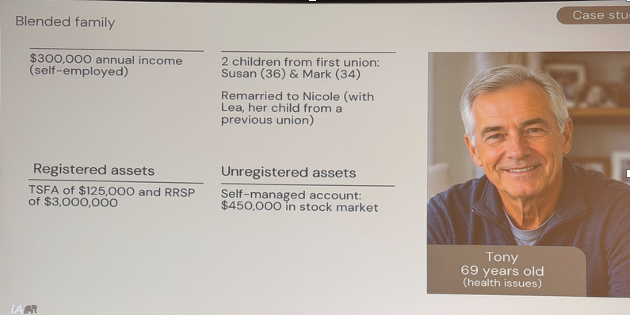
The difficult part is not simply the amount of wealth
In the training case, Tony wants to provide for his current partner while also leaving wealth to his two adult children from an earlier relationship.
His assets include a substantial RRSP, a TFSA and non-registered investments. When both family relationships and asset types become more complex, the question is no longer just “How much will each person receive?” It is also:
Which path will each asset follow, and who will ultimately receive it?
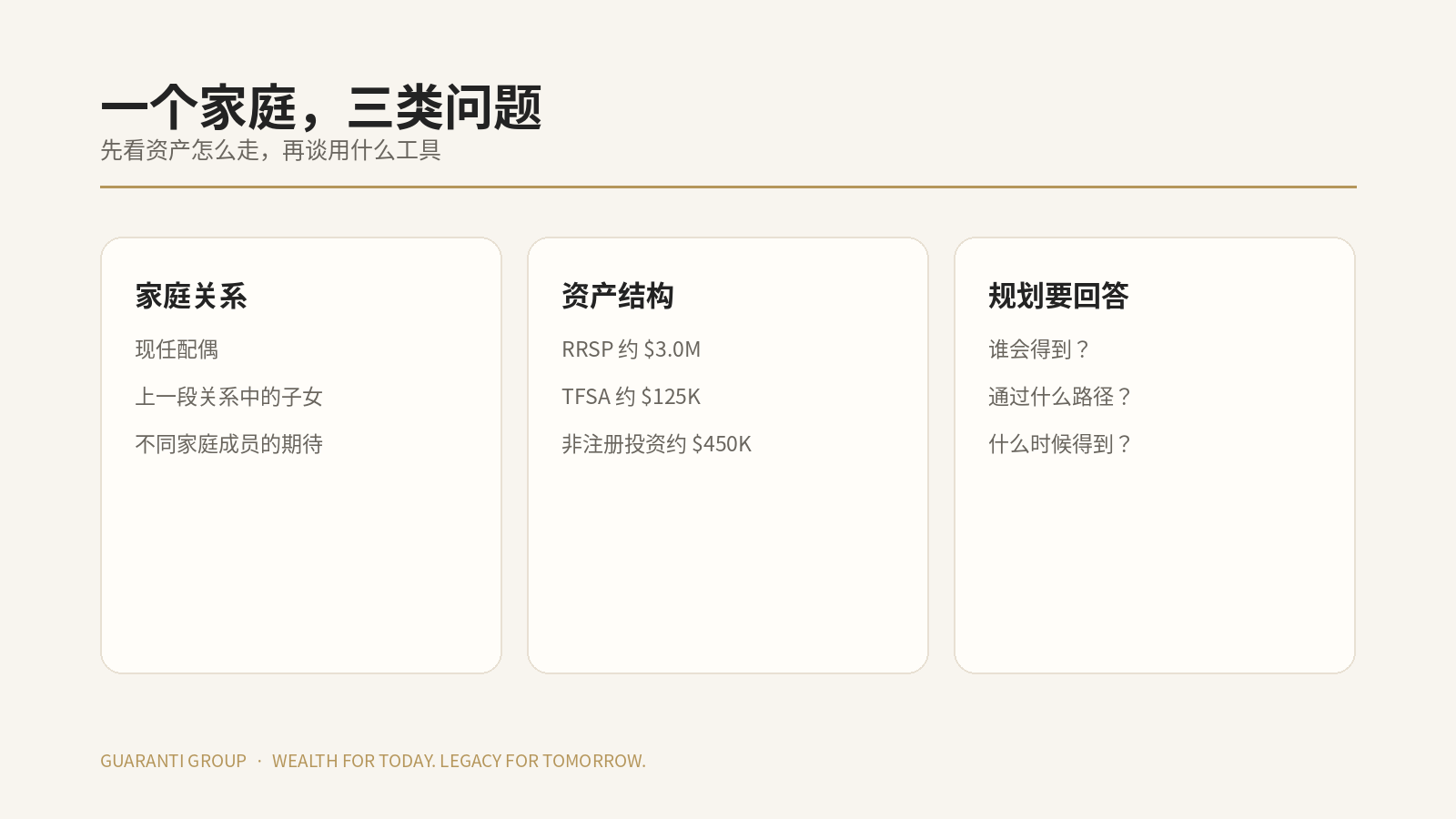
Layer 1 | What paths exist beyond the will?
A will is an essential part of estate planning, but it does not necessarily govern every asset a family owns. Different accounts and contracts may have different ownership arrangements, beneficiary designations and treatment at death.
Each asset raises its own questions:
- Who owns it? Is it held individually, jointly or through another structure?
- Is a beneficiary already named? RRSPs, TFSAs and insurance contracts should each be checked; the will alone is not enough.
- Will it become part of the estate? Different paths may affect timing, costs and privacy.
- Where might tax obligations arise? The person who receives an asset and the party responsible for related tax are not necessarily the same.
Layer 2 | With a $3 million RRSP, are the beneficiary and tax questions the same?
This is a central question in the case. For an RRSP that has not begun paying retirement income, the Canada Revenue Agency’s general rule is that the fair market value of the plan at death is usually treated as having been received by the holder immediately before death and included in the final tax return. Different transfer or tax-deferral rules may apply in eligible cases involving a spouse, common-law partner or certain other qualifying beneficiaries.
That is why planning for a large RRSP cannot stop at “Whose name is on the beneficiary form?”
Who receives the asset, whether it passes through the estate, and where tax obligations arise need to be considered together.
Layer 3 | What can a segregated fund do—and what can it not do?
The training also discussed segregated funds: insurance-company products that combine investment and insurance-contract features. The point is not that they are inherently “better” than ordinary investments. The question is whether a particular family needs specific estate-transfer or risk-management features for part of its assets.
- A more defined beneficiary path. Subject to the contract and applicable law, a death benefit may be paid directly to a named beneficiary without passing through the usual probate process. This may improve transfer efficiency and offer a measure of privacy.
- Guarantees at specified points. Contracts may offer a maturity guarantee or death-benefit guarantee. The percentage, term and conditions depend on the contract; market values can still fluctuate along the way.
- Potential protection under certain conditions. Some arrangements may provide creditor protection if the applicable requirements are met. It is not automatic and depends on such factors as the beneficiary relationship, timing, facts and governing law.
Just as importantly, a segregated fund does not replace a will, tax planning or a broader estate plan.
It is one tool among many.
The Guaranti perspective | Map the paths before choosing the tools
The key issue in Tony’s case is not simply whether to buy a segregated fund. When family relationships, asset types and intended recipients are all intertwined, looking only at the will, an investment account or an insurance contract shows just one part of the picture.
We find it more useful to place four questions on the same map:
- Who owns each asset?
- How would it transfer?
- Where could tax obligations arise?
- Who does the family ultimately want to benefit?
Only after those questions are clear can a family consider what belongs in the will, what should be addressed through beneficiary designations, and where investment, insurance or other professional structures may fit.
Start with the family, then examine the assets. Map the paths before choosing the tools.
That is the perspective behind Guaranti Wealth Class: starting with a real planning question to understand the structures and choices behind a family’s wealth.
This example is adapted and generalized from case materials studied at the iA Leader Summit; it is not an actual Guaranti Group client case. The RRSP discussion draws on the Canada Revenue Agency’s guidance on RRSPs after death. The general segregated-fund features draw on consumer materials from the Canadian Life and Health Insurance Association (CLHIA). This article is general information, not investment, insurance, tax, accounting or legal advice. Any arrangement should be assessed against its contract terms, applicable law and personal circumstances with qualified professionals.
First published on Guaranti’s WeChat account.